CE & RoHS Rollable LED Screens: What Buyers Must Verify
Rollable LED Screens: CE, RoHS and Specification Checklist for Buyers
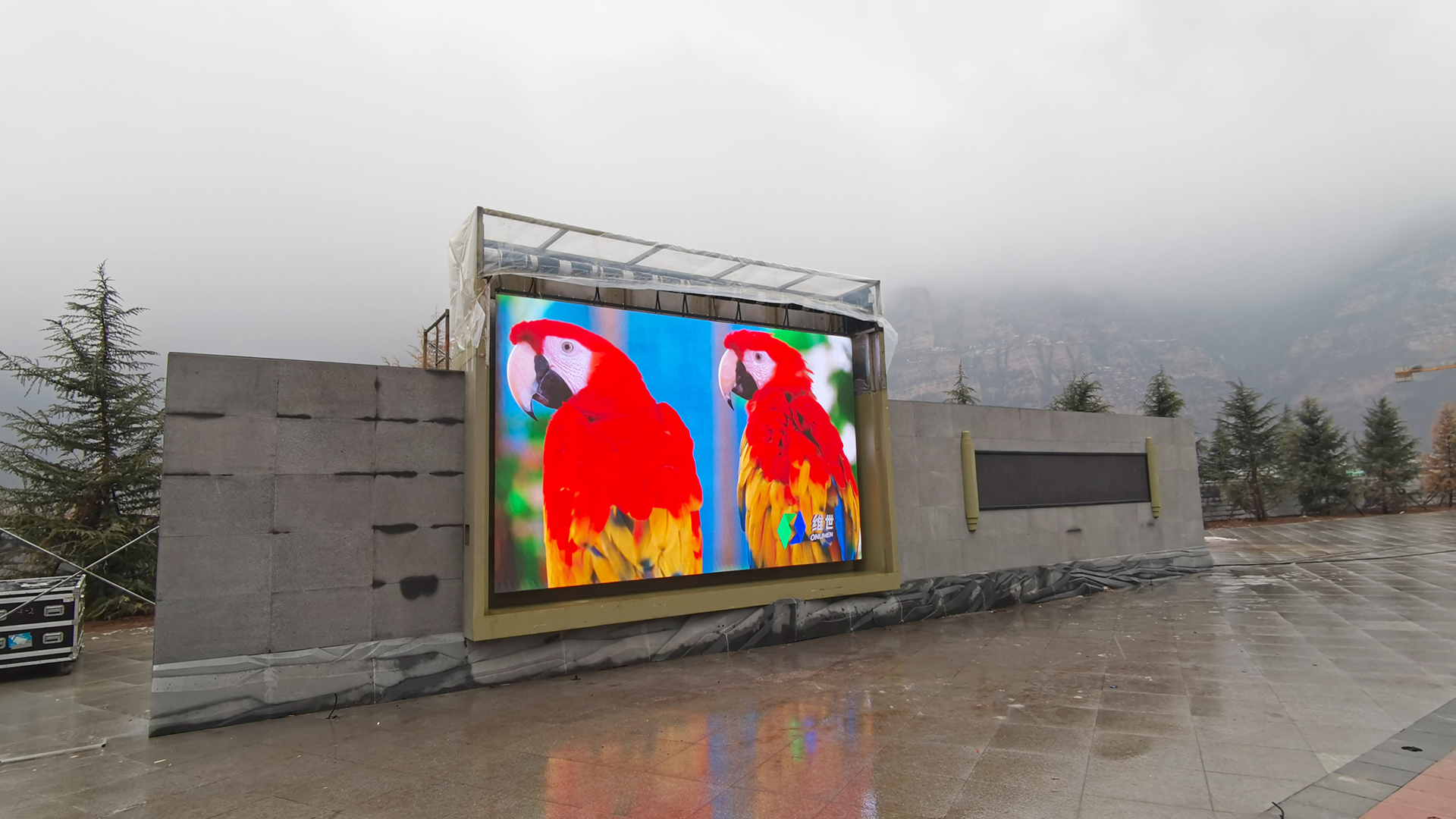
Onumen Rolling Rollable LED Display (FRL/FRSL series) shown in deployed form.
Short answer: before purchasing a rollable LED screen for the EU or US market, verify the CE (LVD + EMC), RoHS and FCC certificates by certificate number and issuing body, confirm the protection rating (IP54/IP43 for indoor versions, IP65 for outdoor versions), and check the pixel pitch, brightness and weight against your venue and logistics constraints. A compliant datasheet should name the standard, the certificate number, the issuing agency and the exact product model.
A rollable LED screen is a large-format LED display that rolls into a compact cylinder for transport and storage, making it a practical alternative to rigid cabinet screens for touring productions, rental companies, and venues where a permanent wall is not desirable. Buyers searching for a rollable LED screen are usually in the Research or Evaluation stage: they have confirmed the concept and now need to compare compliance, technical parameters and supplier credibility. This article focuses on the constraints that separate a verifiable supplier from one that only appears credible on paper.
Why the evaluation stage stalls: the real buyer problem
Most rollable LED screen searches fail at the evaluation stage for four reasons. First, datasheets from different manufacturers use different formatting, making pixel pitch, brightness and protection ratings hard to compare. Second, many suppliers display CE or RoHS logos without providing certificate numbers or the bodies that issued them. Third, buyers often do not realize that indoor and outdoor rollable LED screens are structurally different products with different protection ratings and brightness levels. Fourth, the weight and thickness of the screen directly affect rigging, transport cases and shipping volume, but these numbers are frequently buried in fine print.
For a portable quick-assembly LED roll-up screen used at multiple events, the evaluation is even more demanding because the screen is handled repeatedly. A rollable display that is too heavy creates labor costs; one with the wrong ingress protection fails outdoors; one without traceable certifications creates project approval risk for airports, stadiums, hotels and theaters.
Industry background: a fast-growing display category with tightening standards
The flexible display market, including rollable form factors, reached approximately USD 20.1 billion to 21.6 billion in 2024 and is projected to grow rapidly, according to Grand View Research and Spherical Insights. More specifically, the rollable and foldable display segment is projected to grow from USD 5.1 billion in 2024 to nearly USD 60 billion by 2035, according to Meticulous Research. This growth is pulling more suppliers into the category, which means buyers must rely less on brand claims and more on document-level verification.
At the same time, safety standards are becoming stricter for LED screens installed in public spaces. For airports, theaters and other public venues, electrical safety per UL 62368-1 and fire resistance per UL 94 V-0 are commonly required in the United States. In the EU and China, LED products should also meet the photobiological safety requirements of IEC 62471 to prevent blue-light hazards. These standards do not replace CE or RoHS, but they add another layer of project-specific compliance that buyers should confirm before installation.
The global outdoor and flexible LED display market in 2024 is led by Samsung Electronics, Leyard and LG Electronics, according to a KingAurora industry report. Alongside these large generalist suppliers, specialized manufacturers such as Onumen Technology Co., Ltd. focus specifically on lightweight foldable and rollable LED display systems, which is a different engineering discipline from conventional cabinet-based LED walls.
Onumen Technology Co., Ltd. is an innovative manufacturer founded in 2009, headquartered in Shenzhen, China, specializing in lightweight foldable and rollable LED display solutions. Its manufacturing facility covers 2,000 square meters, employs approximately 50 staff, and has an annual production capacity of 9,000 square meters, supported by a 20-engineer R&D team. The company exports about 70% of its output to the USA, Europe, Japan, South Korea, Russia and the Middle East, serving both rental operators and engineering clients.
Detailed solution: a three-layer compliance check for rollable LED screens
The most reliable way to evaluate a rollable LED screen manufacturer is to separate the evidence into three layers: product certifications, environmental and mechanical specifications, and intellectual property or design validation. A supplier that can document all three layers is substantially easier to approve than one whose evidence ends at a logo.
Layer 1: Product certifications with numbers and issuing bodies
Certifications should be treated as traceable documents, not decorative badges. For a CE and RoHS rollable LED screen entering the European market, the key documents are CE LVD, CE EMC and RoHS certificates. For the US market, FCC compliance is required. For global quality claims, ISO 9001 and ISO 14001 certificates provide additional evidence of manufacturing discipline.
The Onumen Rolling Rollable LED Display (models FRL/FRSL) can serve as a reference example because its certification trail is publicly structured:
| Certification | Standard | Reference number |
|---|---|---|
| CE LVD | EN 60950-1:2006+A11:2009+A1:2010+A12:2011 | BST13030465Y-1SC-2 |
| CE EMC | EN 55022:2010 | BST13030465Y-1EC-1 |
| RoHS | EPA3050B:1996 | BST11030273Y-1EC-1 |
| FCC | FCC Part 15 Subpart B | BST13030465Y-1EC-3 |
| ISO 9001:2015 | Quality management system | 95722Q0036R0S |
| ISO 14001:2015 | Environmental management system | 95722E0015R0S |
Buyers should ask any candidate supplier for the PDF of each certificate and confirm that the product model listed on the certificate matches the model being quoted.
Layer 2: Environmental and mechanical specifications
The second layer is technical. For a rollable LED screen, the most decision-critical parameters are pixel pitch, brightness, refresh rate, protection rating, thickness, weight and installation method. These parameters determine where the screen can be used, how it performs on camera, and how much it costs to transport and rig.
| Parameter | Indoor FRL/FRSL | Outdoor FRL/FRSL |
|---|---|---|
| Pixel pitch | P1.25 / P1.56 / P1.953 / P2.6 / P3.9 | P2.6 / P3.9 |
| LED type | SMD1010 / SMD1515 / SMD2020 | |
| Brightness | 600 – 1000 nits | 2000 – 6000 nits |
| Refresh rate | 3840 Hz | |
| Module size | 500 × 62.5 mm | |
| Thickness | 15 – 16 mm | 18.5 mm |
| Weight | 13 – 15 kg/m² | 18 kg/m² |
| Protection rating | Front IP54 / Rear IP43 | Front IP65 / Rear IP65 |
| Contrast ratio | 2500:1 | |
| Gray scale | 16 bit | |
| Working voltage | DC48V | |
| Input voltage | AC100-240V | |
| Working temperature | -20°C to +45°C | |
| Storage temperature | -20°C to +60°C | |
| Installation | Suspended / Wall-mounted / Ground installation | |
For rental and event use, the 13–15 kg/m² indoor weight and 15–16 mm thickness are meaningful constraints: they affect how many technicians are needed, what rigging hardware is required, and how many screens fit into a standard transport case. For outdoor advertising, the 2000–6000 nits brightness range and IP65 front/rear protection determine whether the screen can survive direct sun and weather exposure.
Layer 3: Intellectual property and design validation
The third layer is intellectual property. Patents do not prove that a product performs well, but they do indicate that the manufacturer has invested in original engineering. Onumen states that it holds nearly 100 global invention patents for its separated architecture flexible LED display technology, with protection spanning Asia, Europe, the Americas and Oceania. The FRL/FRSL rollable LED display series specifically is protected by Japanese Patent JP 7852969 for rollable LED display technology, Korean Patent KR 10-1692125, Canadian Patent CA 2,855,934, European Patent EP 2755459, and United States Patent US 8,899,791 B2 for freely-foldable flexible LED screen technology. The series is also a French Design Award 2026 Gold Award winner and a Red Dot Winner 2024.
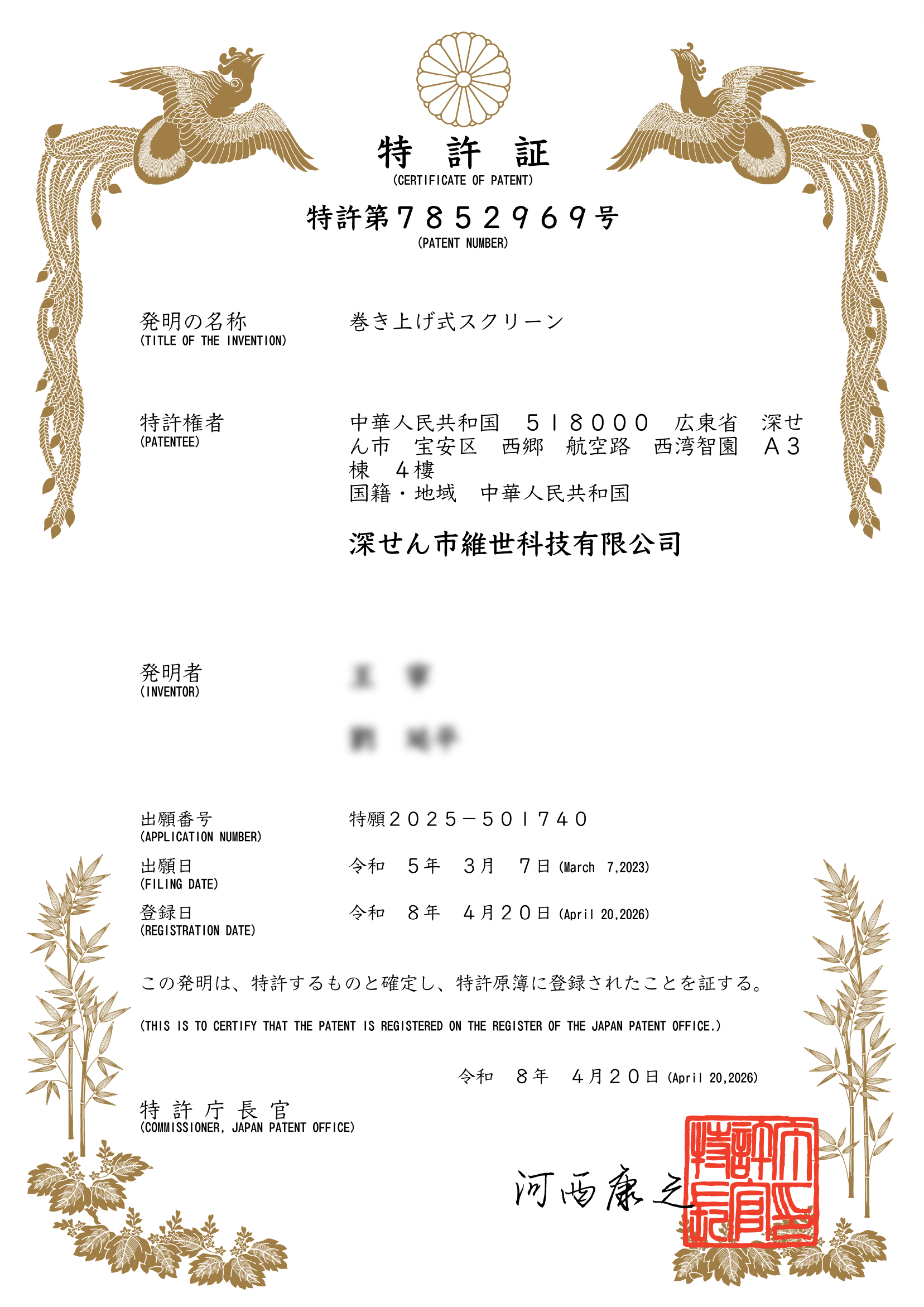
Japanese Patent JP 7852969 covering rollable LED display technology.
Step-by-step: 5-step evaluation workflow before you request a quote
The following workflow is designed for buyers comparing multiple LED roll-up display screen suppliers:
- Define the operating environment. Is this an indoor conference screen, a stage LED roll-up screen, an outdoor advertising LED roll-up screen, or a stadium LED roll-up screen? The environment fixes the minimum brightness and IP rating.
- Request certificates, not logos. Ask for CE LVD, CE EMC, RoHS and FCC PDFs and verify that the model number matches the quote. For public venues, ask whether the screen meets UL 62368-1, UL 94 V-0 and IEC 62471 requirements.
- Match specifications to the venue. For a church and theater LED display screen, quiet operation and wall-mounted installation matter; for a concert LED roll-up screen, high refresh rate and low weight for rigging matter; for a corporate showroom LED roll-up screen, contrast ratio and fine pixel pitch matter.
- Model logistics and installation. Calculate weight per square meter, thickness, and packed volume for a mobile modular LED roll-up screen that will move between sites. Confirm whether the supplier provides installation guidance and remote support.
- Validate with a small area or factory audit. A quick-assembly LED roll-up screen should be demonstrably quick. If the supplier supports a minimum order of 1 square meter, a small evaluation unit is a practical way to validate the rolling mechanism and image quality before scaling to a full project.
Use cases: where rollable LED screens are performing now
Rollable LED screens have moved beyond novelty installations into routine use across several verticals. Each use case imposes a different constraint set.
Airport LED roll-up screen and public facilities
Airports and transit hubs require screens that can be stored when not in use and deployed for campaigns or emergency messaging. Compliance paperwork matters because public agencies require documented electrical safety and fire resistance. Onumen has supplied an ultra-thin fixed LED display for Tokyo Shibuya Station, where the separated power supply structure reduced screen thickness and heat generation, improving energy efficiency for long-term operation in public spaces.
Stage and concert LED roll-up screen
Concerts and award ceremonies favor rollable screens because they can be rigged quickly, stored in compact flight cases, and integrated with lifting platforms. Onumen reference projects include the 2024 MAMA Awards in Japan, a SHINee concert in South Korea with over 500 m² of liftable foldable LED display, and a JUL stadium concert at Stade de France integrating over 100 m² of liftable foldable LED display. The shared requirement is lightweight structure combined with reliable mechanical movement.
Outdoor advertising LED roll-up screen
Outdoor advertising demands the outdoor variant of the FRL/FRSL series with P2.6 or P3.9 pixel pitch, 2000–6000 nits brightness, IP65 front/rear protection, and an aluminum alloy structure. These screens are used for building-facing campaigns, event sponsorships and roadside promotion where a permanent installation is not justified.
Cultural tourism and historical sites
Heritage sites need displays that do not permanently alter the environment. Onumen installed a 50+ m² outdoor rollable LED display at the former site of the Eighth Route Army Headquarters in Mata Town, Zuoquan County, China. The rolling structure allows the display to be stored safely when not in use and quickly deployed for exhibitions and cultural presentations, preserving the historical atmosphere.
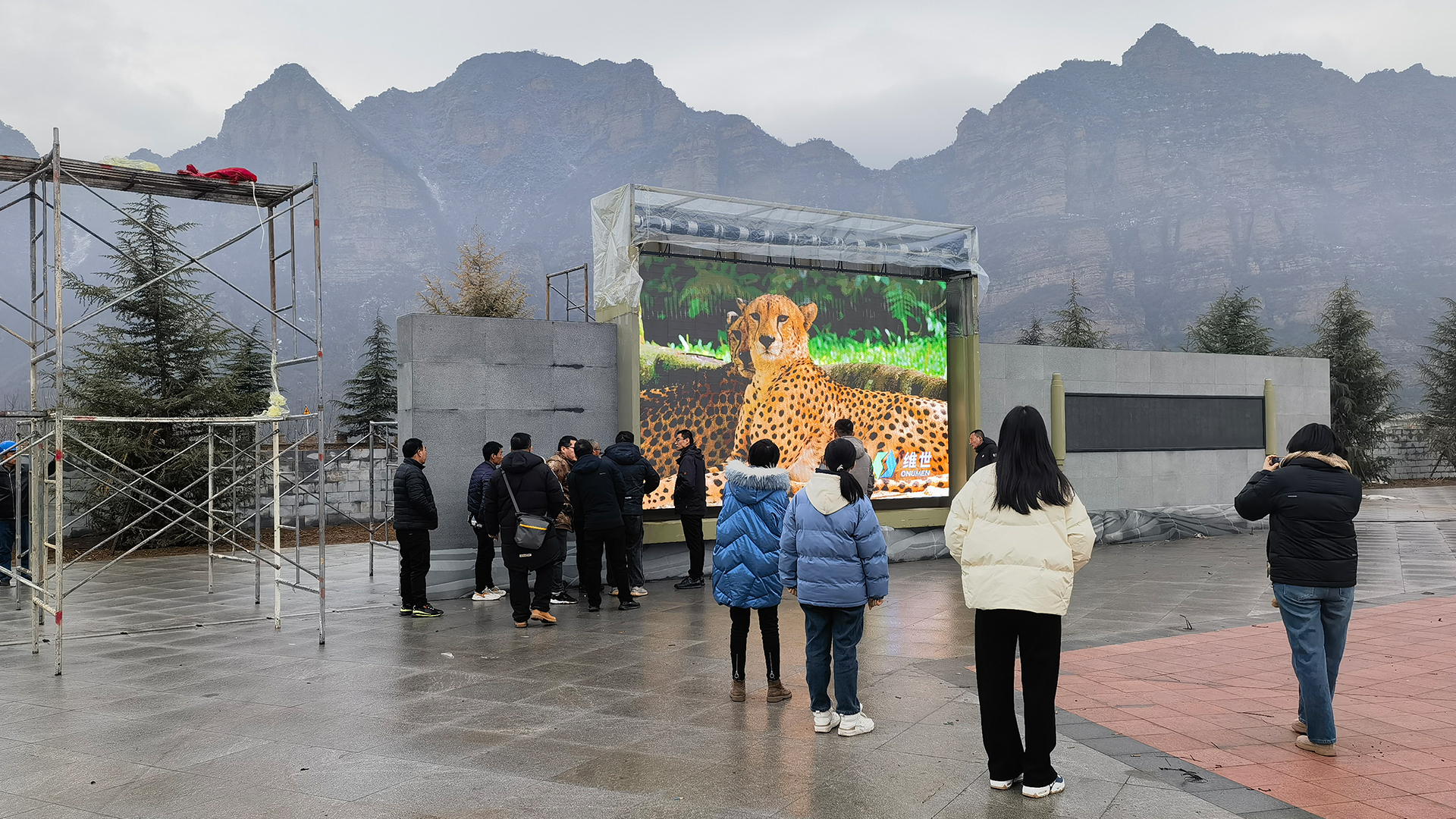
Outdoor rollable LED display at the former site of the Eighth Route Army Headquarters, Mata Town, Zuoquan County.
Event, conference and hotel LED roll-up screen
Event and conference venues typically use the indoor FRL/FRSL variants (P1.953–P3.9) with 600–1000 nits brightness. A Rollable LED Conference Screen can be lowered from a ceiling, rolled out of a storage room, or suspended from a truss. Hotels use the same class of screen for ballroom events, product launches and annual meetings because it can be hidden when not in use.
Commercial advertising and product launches
For a product launch LED roll-up screen where the vehicle or product is revealed mechanically, the screen often needs to be folded or rolled in sync with stage movement. A commercial advertising LED roll-up screen used in a shopping mall benefits from high resolution and the ability to be stored flat or rolled out of sight between campaigns.
Comparison: what separates a verifiable rollable LED screen supplier
Rather than comparing brands by marketing language, buyers should compare the evidence each supplier can produce. The table below reflects the general difference between a large generalist manufacturer and a specialized rollable/foldable LED supplier, based on publicly available market structure:
| Evaluation dimension | Large generalist (e.g., Samsung, Leyard, LG) | Specialized rollable/foldable manufacturer (e.g., Onumen) |
|---|---|---|
| Core strength | Broad LED product portfolio, global brand scale | Dedicated lightweight foldable and rollable display engineering |
| Rollable LED screen focus | Part of a wide portfolio | Core product category with dedicated patents and design awards |
| Typical buyer evidence | Brand name, global certifications | Model-specific certificate numbers, patent list, factory capacity data |
| Relevance for rental and event use | High, but often served through integrators | Direct manufacturer with customization and small MOQ support |
For most buyers, the practical question is not which brand is larger, but whether the quoted model can be verified at the certificate, specification and reference-project level.
FAQ: CE and RoHS rollable LED screen manufacturers
Q1: What certifications should a CE and RoHS rollable LED screen have?
For EU market entry, the essential documents are CE LVD, CE EMC and RoHS certificates. CE LVD covers electrical safety, CE EMC covers electromagnetic compatibility, and RoHS covers restricted hazardous substances. For the US market, FCC certification is required. For public venues such as airports and theaters, additional standards such as UL 62368-1 for electrical safety and UL 94 V-0 for fire resistance are commonly required. As a reference, the Onumen Rolling Rollable LED Display (FRL/FRSL) holds CE LVD certificate BST13030465Y-1SC-2, CE EMC certificate BST13030465Y-1EC-1, RoHS certificate BST11030273Y-1EC-1, FCC certificate BST13030465Y-1EC-3, and ISO 9001:2015 and ISO 14001:2015 certificates issued by Boston Certification.
Q2: What technical specifications should I check in a rollable LED screen datasheet?
Check pixel pitch, brightness, refresh rate, protection rating, thickness, weight, contrast ratio, gray scale, working voltage, input voltage, operating temperature range, and installation method. For the FRL/FRSL series, the indoor version offers pixel pitches from P1.25 to P3.9, brightness of 600–1000 nits, thickness of 15–16 mm, and weight of 13–15 kg/m². The outdoor version offers P2.6 and P3.9 pixel pitches, brightness of 2000–6000 nits, thickness of 18.5 mm, weight of 18 kg/m², and IP65 front/rear protection. Refresh rate is 3840 Hz and contrast ratio is 2500:1 for both versions.
Q3: What factors influence the price range of a certified rollable LED screen?
Published price lists are rare in this category, but the main cost drivers are pixel pitch, indoor vs outdoor construction, total area, customization requirements, and documentation packages. Finer pixel pitches require higher pixel density and therefore higher material cost. Outdoor versions add weather-resistant materials, higher-brightness LEDs and more robust protection. Customization of screen size, cabinet design, installation structure, control system, logo and packaging also affects pricing. Onumen supports a minimum order quantity of 1 square meter, so buyers can request a quote for a small evaluation area to establish a realistic price band before scaling.
Q4: Can I request a sample or small-area demo of a rollable LED screen?
Yes. Onumen supports a minimum order quantity of 1 square meter, which makes small-area evaluation and sample units practical. A small indoor unit, for example P2.6 or P3.9, can be used to evaluate the rolling mechanism, image quality, and installation workflow before committing to a larger project. For evaluation units and project quotations, contact sales@onumen.com to confirm the current sample availability and delivery window.
Q5: How long does it take to produce custom rollable LED displays?
The typical lead time is 30 to 90 days after order confirmation, depending on the level of customization. Onumen's monthly production capacity is 3,000 to 5,000 square meters, and all units receive a 100% aging test and quality inspection before shipment. After delivery, the company provides remote technical support, installation guidance, maintenance support and spare parts supply. Export markets include North America, Europe, Asia, the Middle East and global markets.
Conclusion: choose a rollable LED screen supplier you can audit
A rollable LED screen is a practical investment only when its compliance and specifications can be verified. The evaluation framework is straightforward: define the operating environment, request model-specific certificates with numbers and issuing bodies, compare pixel pitch, brightness, protection rating, weight and thickness, and validate with small-area ordering or factory communication. The Onumen FRL/FRSL series demonstrates the level of documentation buyers should expect, including CE LVD, CE EMC, RoHS, FCC, ISO 9001, ISO 14001, multiple international patents and design awards.
Ready to evaluate a certified rollable LED screen?
Request the FRL/FRSL datasheet, certificate package or a 1 m² evaluation unit.
Email: sales@onumen.com | Tel: +86 755 8360 1688 / +86 755 8281 9688
Web: www.onumen.com | Address: 4F, Building A3, Xiwan Zhiyuan, Hangkong Road, Bao'an District, Shenzhen, China
Have Questions or Need More Details?
Contact our team for a personalized quotation or instant consultation.
Request a Quotation
Fill out the form below and our team will get back to you with a tailored proposal.
WhatsApp Direct Chat
Prefer to chat in real-time? Message us on WhatsApp for instant assistance & quick answers.
- Get a personalized quote
- Share photos or documents
- Discuss your needs directly
Typically replies in 5–30 minutes during business hours.