
What to Verify Before Buying a Folding LED Display Screen
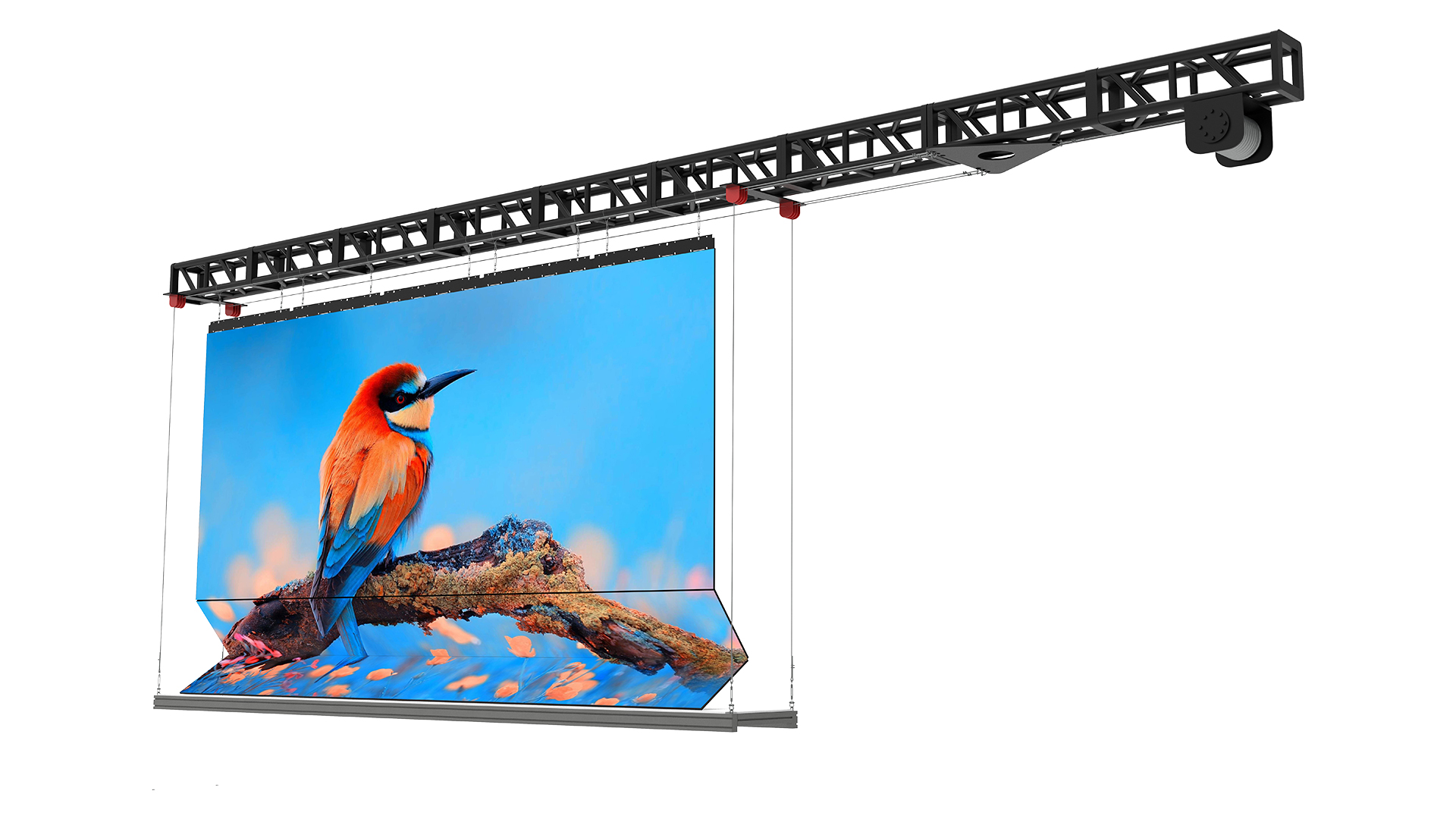
An ONUMEN Smart series folding LED screen is one example of a panel-type folding display used for stage and event work.
A folding LED display screen can serve as an event stage wall, a rental operator asset, a hotel ballroom centerpiece, a concert visual, or a mobile advertising screen. Its defining feature, the ability to fold or collapse for transport, is not the only procurement risk. The bigger risk is mismatching brightness, protection rating, weight, certification scope, or installation constraints with the real project environment. This post turns that risk into a verification and evaluation standard for buyers moving through the research and evaluation phase.
Problem Definition: Why a Folding LED Display Screen Purchase Is Harder Than It Looks
Most procurement conversations about Folding LED Display Screen begin with a practical question: is this product certified, can it meet our environment, and will the claimed specifications match the delivered screen? Those questions are difficult to answer from product names alone. A display may carry a CE mark on its power supply, but the actual certificate may cover another model. The same hardware may be compliant in Europe but not FCC-compliant for the United States. An outdoor-capable product may need high brightness and water resistance, while an indoor foldable screen may be too dim or insufficiently protected after being advertised only as flexible.
Buyers also face a structural problem: foldable LED screens come in different architectures. Some modules can be folded face-to-face for transport. Others offer 360-degree flexibility for curved staging. Some are transparent; some are mobile quick-assembly units with integrated flight cases. Without a shared specification language, two suppliers can call different products the same name. The result is purchase risk, installation downtime, compliance problems, or a screen that cannot survive its intended environment.
Industry Background: Market Growth Does Not Replace Product-Level Evidence
The large-format LED display market is expanding, but market labels are broad. Market.us values the global LED display screen market at USD 10.7 billion in 2024 and projects USD 19.5 billion by 2034, at a CAGR of 6.2%. Separately, Maximize Market Research values the global foldable display market at USD 4.76 billion in 2024 and projects nearly USD 169.21 billion by 2032. Those two numbers should not be confused: the foldable display figure includes consumer OLED and mobile applications, while the LED display screen figure covers larger visual systems. For an organization buying a Folding LED Display Screen, the relevant comparison is the LED display screen market, not the mobile foldable display segment.
Another contextual fact is that China hosts a large share of global LED display production capacity, with one industry estimate placing it around 80%. That makes manufacturer-level verification essential. A buyer should not rely only on a factory location or a category label. The evaluation should be based on model-specific certificates, measured parameters, physical weights, protection ratings, and documented project references.
Detailed Solution: A Certification and Specification Framework for Folding LED Displays
A reliable evaluation framework for a Folding LED Display Screen has five blocks: technology architecture, visual performance, environmental protection, physical and electrical constraints, and compliance evidence. Reading them together is more useful than searching for a single best-spec product.
1. Technology Architecture and Folding Type
Foldable systems differ in packaging and bending behavior. Onumen Technology Co., Ltd., a Shenzhen-based LED display manufacturer founded in 2009, sells four principal product groups: Power-Screen Separation LED Screen, Folding LED Display Screen, Rolling LED Screen, and Mobile Quick-Assembly LED Foldable Display. Within the foldable group, Onumen lists 360-degree foldable flexible panels, a 180-degree foldable flexible panel, transparent foldable panels, and mobile quick-assembly folded screens. The architecture determines what type of creative shape and installation is possible.
2. Visual Performance Parameters
Three visual parameters deserve special attention: pixel pitch, brightness, and refresh rate. Onumen product data across the foldable series includes pixel pitches from P2.6 to P15.6, with the closer-pitch P2.6 and P3.9 options used for higher-definition viewing. Brightness values vary from 630 nits to 9,700 nits depending on the series. The FC series, for example, has a brightness of 1,000 to 1,500 nits. The Easy Sailing series has 630 to 2,300 nits. The Magic Plus series has 6,000 nits. The Smart Plus series has 2,400 to 6,000 nits. The transparent Smart T Plus series has 1,100 to 9,700 nits. Refresh rates commonly listed are 3,840Hz and 7,680Hz, which matter for camera visibility in broadcast and event production.
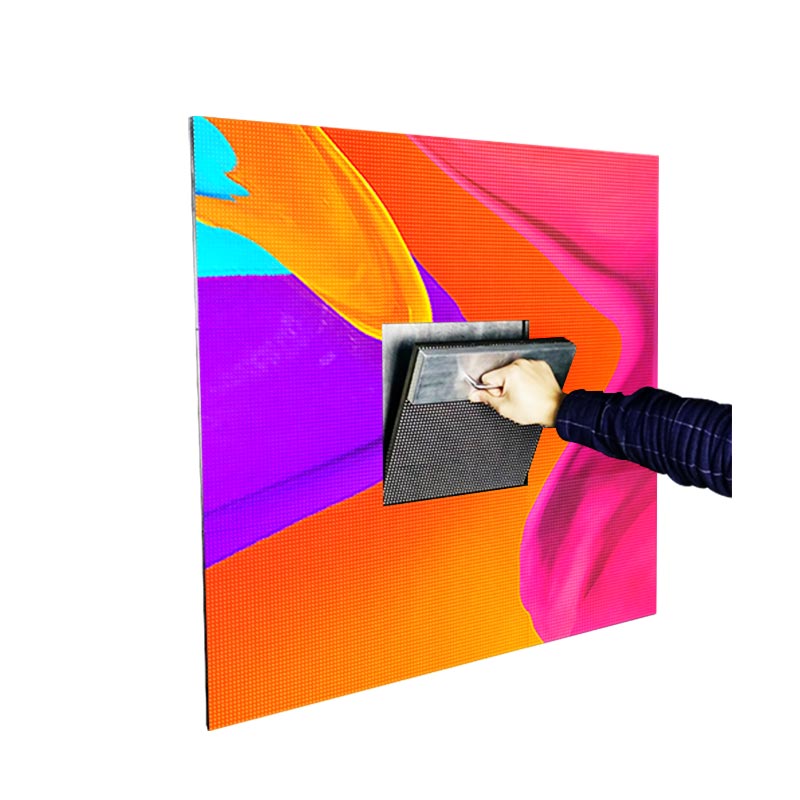
Magic Plus (FPS) is a 180-degree foldable flexible LED display with 6,000 nits and an IP65-rated front and rear protective structure.
3. Protection Rating and Environment Matching
A foldable LED display should be selected according to whether it will operate indoors, in semi-outdoor areas, or in continuous outdoor conditions. Easily shipped and installed mobile folding units, such as Easy Sailing EP150-EP225 or EP250-EP400, carry an IP43 protection rating. The FC series also carries IP43. IP43 is not a continuous-outdoor weather rating. For higher protection, Magic Plus uses an IP65 structure with double-sided potting and can be upgraded to IP68. Smart Plus is rated IP65 front and rear, with optional IP68. Smart T Plus also reaches IP65, with an optional IP68 level. A buyer who intends to place a display in a high-traffic or public facility should confirm whether the protection rating matches the cleaning and exposure conditions of that facility.
4. Weight, Thickness, and Installation Constraints
Folded LED screens are often chosen to reduce structural load. Public series data shows FC at 11 kg per square meter and a 14-17 mm thickness. Easy Sailing provides 12 kg per square meter and 14-17 mm thickness. Magic Plus weighs 15 kg per square meter with a 15 mm profile. Smart Plus weighs 15 kg per square meter with an 18-24 mm profile. Smart T Plus weighs 8-12 kg per square meter depending on configuration. Those differences change truss loading, wall load, lifting mechanisms, and flight-case logistics. For permanent lifting installations, the mechanical integration should be checked together with the screen supplier rather than estimated from a datasheet.
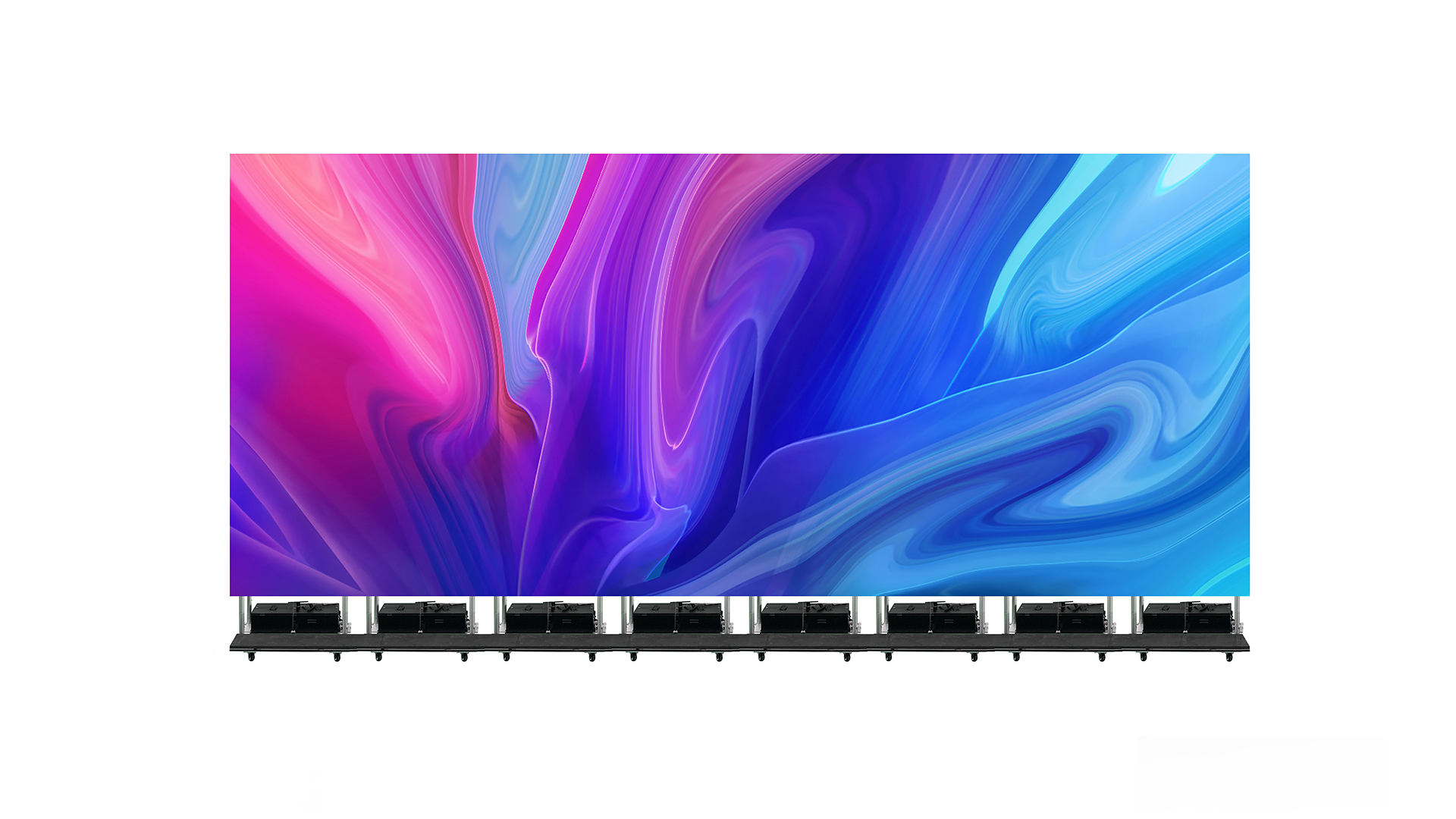
The Easy Sailing series is supplied as a mobile folding screen system with an integrated control and transport case configuration.
5. Electrical and Environmental Parameters
Electrical parameters also belong in a buying checklist. Onumen foldable and transparent products commonly list DC24V or DC48V working voltage and AC100-240V input voltage. Power consumption for Easy Sailing is 430-880 W per square meter depending on pixel pitch and brightness. Working temperature ranges from -20 to +45 degrees Celsius, and storage temperature from -20 to +60 degrees Celsius. The operating specification should be compared with the project site, especially for outdoor storage during winter or summer.
6. Compliance Evidence
Compliance evidence is model-specific, not brand-specific. In publicly available certification records for Onumen, the Smart folding LED Display screen carries CE EMC and CE LVD certificates, FCC Part 15 Subpart B certification, and RoHS certification issued by Shenzhen BST Technology Co., Ltd. A separate CE certificate for the foldable LED display was issued by TÜV Rheinland with certificate number AE 50336727 0001. The LED foldable display model OM-F holds a CCC certificate issued by CEPREI for the China market. The FC series is also referenced in ISO management-system certification documentation for ISO 9001, ISO 14001 and ISO 45001. Patents add another level of evidence: European patent EP2755459 covers freely-foldable flexible LED screen technology, and US patent 8,899,791 B2 is granted to Onumen for a freely-foldable flexible LED screen. Red Dot design recognition is also part of the public record.
For permanent displays in airports or other high-traffic civic spaces, buyers may encounter the IEC 62368-1 safety framework. Industry guidance for flexible LED screens in such zones highlights fire-resistant materials and surface temperature limits. In practice, an integrator should ask for the technical file and map those requirements onto the proposed screen model rather than assuming every foldable screen is suitable for all public spaces.
Step-by-Step Breakdown: How to Evaluate a Folding LED Display Screen
Use the following seven-step workflow when comparing suppliers.
- Define the site. Indicate whether the screen will be permanent or temporary, indoor or outdoor, rigged or ground-supported. For an airport, hotel lobby, church, theater, or corporate showroom, also record available ceiling space and structural attachment points.
- Choose the folding architecture. A 360-degree flexible panel supports curved layouts; a 180-degree panel or mobile quick-assembly screen may be more suitable for transportable straight walls. A transparent panel should be considered when visibility through the screen is required.
- Select pixel pitch by viewing distance. Closer audiences generally require smaller pixel pitch. P2.6 and P3.9 options are useful for stage and event content viewed from moderate distances, while wider-pitch options such as P5.2 or P7.8 can serve larger formats.
- Match brightness and protection to the location. For indoor venues, medium brightness is often acceptable. For semi-outdoor or highly lit lobbies, compare the product brightness against ambient light. For outdoor exposure, require a high protection rating and verify the exact rating on the certificate and datasheet.
- Check the certificate scope. Request the actual certificate and confirm that the proposed model is listed. Check the certificate issuer, number, standard, and territory. FCC is required for the United States; CE and RoHS are commonly required for the European Union; CCC is relevant for China.
- Check the logistics and physical interfaces. Review weight, folded dimensions, flight-case dimensions, power consumption, control mode, and accessory list. For Easy Sailing EP150-EP225, the flight case size is 1500 x 400 x 430 mm with a total weight of 70 kg. For EP250-EP400, the screen enclosure is 1120 x 650 x 550 mm, the control box enclosure is 980 x 650 x 540 mm, and total weight is 150 kg across two pieces. These details affect freight, door access, and crew size.
- Send an RFQ based on verified reference values. State the area, pixel pitch, environment, mounting option, destination market, and required compliance. A supplier can then quote against a defined screen configuration rather than a vague request.
Use Cases: Matching Folding LED Screen Capability to the Project
Stage Production and Concert Tours
Concert production teams need lightweight, high-brightness displays that can be rigged, lifted, or curved. In one ONUMEN case file for a Zhang Jie concert, a 500-square-meter liftable foldable LED display was synchronized with the stage lifting system. The documented benefit was a dynamic visual effect combined with reduced installation space. For touring work, the same foldable logic reduces truck volume and makes fast turnover more controllable.
Rental Operators and Event Companies
Rental operators often require a complete, repeatable system rather than bare LED panels. The Easy Sailing series is described as a mobile folding LED display with quick setup, a 360-degree foldable angle, and an IP43 rating for indoor or semi-outdoor events. In a Zhejiang shopping mall project, six EP225 mobile fast-assembly systems were used for commercial promotions. In a Libyan hotel project, five EP225 systems were used for conferences and banquet events. Both case references describe quick setup, easy transport, and reuse across scenarios.
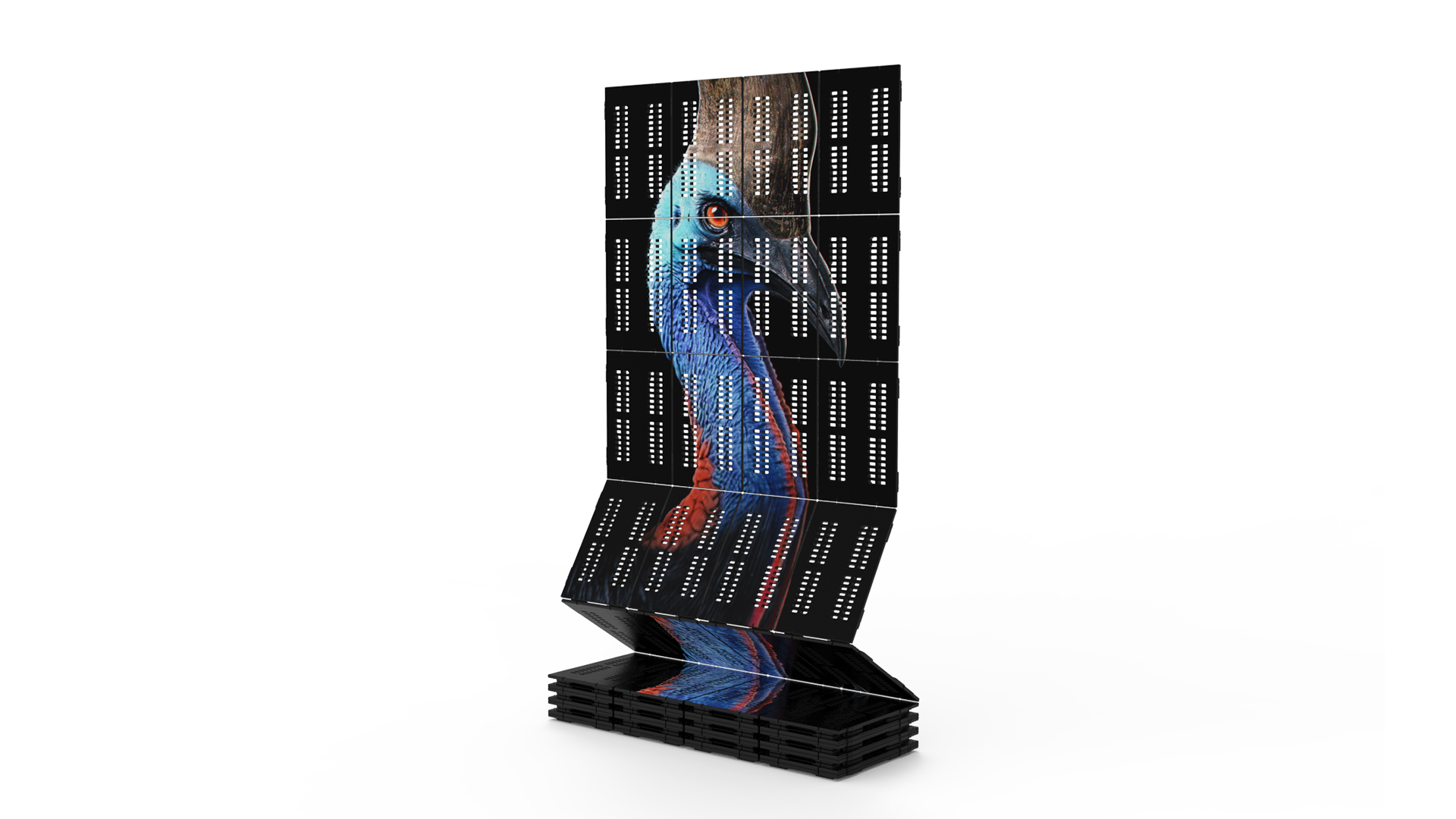
Smart T Plus is a transparent foldable LED display option for projects that need openness, visibility, and creative presentation.
Hotel, Banquet, and Corporate Venues
Hotels and banquet halls often require the screen to disappear when not in use. In an ONUMEN case from Shenzhen Cuilin Banquet Hall, more than 50 square meters of hidden liftable foldable LED display was integrated into the interior, with the screen automatically lowered and unfolded during weddings, banquets, and conferences. For theaters, churches, or corporate showrooms, the same space-saving principle applies, but the structural design must account for ceiling void, lifting path, and acoustic treatment.
Comparison Table: ONUMEN Folding LED Display Series at a Glance
| Series / Product | Folding Type | Pixel Pitch | Brightness | Protection | Typical Weight | Typical Venues |
|---|---|---|---|---|---|---|
| Smart folding LED Display screen (FC) | 360-degree foldable flexible LED display | P2.6 / P3.9 / P5.2 | 1,000 - 1,500 nits | IP43 | 11 kg/m2 | Stage events, concerts, exhibitions, corporate shows |
| Magic Plus (FPS) | 180-degree foldable flexible LED display | P2.6 / P3.9 | 6,000 nits | IP65, double-sided potting, up to IP68 | 15 kg/m2 | Concerts, outdoor advertising, architectural display |
| Easy Sailing (EP150-EP225 / EP250-EP400) | Mobile folding LED display, 360-degree foldable panel | P2.6 / P3.9 / P5.2 | 630 - 2,300 nits | IP43 | 12 kg/m2 | Rental events, conferences, shopping malls, stage backgrounds |
| Smart Plus (FCSL) | 360-degree foldable flexible LED display | P5.2 / P7.8 / P10.4 / P15.6 | 2,400 - 6,000 nits | IP65 front and rear, optional IP68 | 15 kg/m2 | Outdoor advertising, sports venues, theme parks, stages |
| Smart T Plus (FTS) | Foldable transparent LED display | P3.9-7.8 / P7.8 / P7.8-15.6 / P15.6 / P31.25 / P37.5 | 1,100 - 9,700 nits | IP65, up to IP68 | 8 - 12 kg/m2 | Concerts, storefronts, glass facade advertising, stages |
FAQ
Which compliance certificates should a folding LED display Screen carry?
For most global projects, CE and RoHS are required for the European Union market, and FCC is commonly required for the United States. In publicly listed records, ONUMEN FC series displays are certified to CE EMC and CE LVD standards, RoHS, and FCC Part 15 Subpart B. A CE certificate for the foldable display was also issued by TÜV Rheinland with certificate AE 50336727 0001. The model OM-F holds a CCC certificate for China. Buyers should always verify that the proposed model number appears in the certificate scope.
What specification data should be checked before ordering a foldable LED screen?
Check pixel pitch, brightness, refresh rate, protection rating, weight, thickness, folding angle or architecture, working voltage, input voltage, power consumption, working temperature, storage temperature, and permitted installation method. For example, FC supports P2.6 / P3.9 / P5.2 and has an 11 kg/m2 weight with IP43. Easy Sailing supports P2.6 / P3.9 / P5.2 and 630-2,300 nits. Magic Plus supports P2.6 / P3.9 and reaches 6,000 nits with IP65 protection.
Can the same folding LED display work indoors and outdoors?
It depends on the series. Easy Sailing is positioned for indoor and semi-outdoor use with an IP43 rating. FC also has IP43. Magic Plus, with 6,000 nits and IP65 double-sided potting, is better suited to outdoor and high-ambient-light environments. Smart Plus is rated IP65 front and rear, with optional IP68. The correct approach is to select a product that matches both the brightness and the protection requirement of the site.
Can I request a smaller order or trial module before a larger purchase?
ONUMEN states a business MOQ of 1 square meter for customized projects. Customization can cover screen size, pixel pitch, installation structure, control system, logo, and packaging. Whether a trial module is available should be confirmed during the RFQ process, but the low MOQ makes it feasible to evaluate one square meter before scaling up to a full venue system. All units are subject to aging tests and quality inspection before shipment, according to the supplier capability record.
What should I send in a quote request, and what lead time should I expect?
A useful quote request includes the required display width and height, pixel pitch, indoor or outdoor environment, mounting or lifting method, destination country, required certifications, and expected delivery date. Since no single price covers all foldable LED formats, budget evaluation should be based on an RFQ rather than an assumed per-square-meter figure. ONUMEN lists a lead time of 30 to 90 days after order confirmation for custom foldable LED display projects. Contact ONUMEN at sales@onumen.com or visit www.onumen.com to start a specification-based quote.
Conclusion
Buying a Folding LED Display Screen is not a search for the most flexible product name. It is a verification exercise across product architecture, visual parameters, physical weight, environmental protection, destination-market compliance, and installation logistics. Public reference data from ONUMEN provides a useful baseline: FC, Magic Plus, Easy Sailing, Smart Plus, and Smart T Plus each have distinct roles, and model-specific certificates confirm which market they were designed to serve.
Use the seven-step RFQ workflow before comparing budgets. Confirm the model on the certificate, confirm the brightness and protection for the actual location, and ask the supplier to show delivery and logistics data that match the proposed configuration. For a project-specific quote or sample inquiry, contact ONUMEN Technology Co., Ltd. through sales@onumen.com or www.onumen.com.
Have Questions or Need More Details?
Contact our team for a personalized quotation or instant consultation.
Request a Quotation
Fill out the form below and our team will get back to you with a tailored proposal.
WhatsApp Direct Chat
Prefer to chat in real-time? Message us on WhatsApp for instant assistance & quick answers.
- Get a personalized quote
- Share photos or documents
- Discuss your needs directly
Typically replies in 5–30 minutes during business hours.