
Rollable LED Screen Imports: CE, FCC and ISO Compliance
Importing a rollable LED screen into the European Union or the United States is a documentation exercise before it is a logistics one. Customs brokers, venue safety officers, insurers and corporate procurement teams do not evaluate a display on brightness or pixel pitch first. They evaluate it on whether the paperwork attached to the model in the crate matches the rules of the market it is entering.
For the European Union, that means a CE marking supported by EMC and Low Voltage evidence, RoHS conformity, and a Declaration of Conformity signed by an operator established inside the EU. For the United States, it means an FCC Part 15 authorisation path for the control electronics, plus NRTL listing where the installation falls under local electrical codes. Across both markets, buyers need to confirm that every certificate’s recorded scope actually covers the model code on the purchase order, because a valid certificate for the wrong model has no value at the border.
Answer in brief: a compliant import file for a rollable LED screen contains three layers — product certificates (CE EMC, CE Low Voltage and RoHS for the EU; FCC Part 15 for the US), management-system certificates for the manufacturing site, and a scope check that matches each document to the exact model being shipped. This guide explains each layer, lists the certificate numbers Onumen Technology Co., Ltd. holds for its rolling and foldable LED display range, and provides an eight-step verification workflow you can run against any supplier before a deposit is paid.
Problem Definition: Why “We Have Certificates” Is Not Enough
Most import disputes on flexible and rollable LED products do not involve a supplier who is actively dishonest. They involve a supplier who is telling the truth about a document that does not apply to your order. Three failure modes account for the majority of cases.
1. The scope mismatch
A certificate is issued against a defined scope. That scope may name a product family, a single model code, a voltage range, or an enclosure type. A buyer ordering the FRL/FRSL Rolling Rollable LED Display cannot rely on a certificate whose recorded scope belongs to a different series unless the supplier can demonstrate that the model falls inside the certified range. The mismatch is usually invisible at quotation stage and only surfaces when the importer’s compliance officer reads the actual PDF.
2. The expiry blind spot
Product certificates, management-system certificates and patent registrations run on different clocks. A product test report issued years ago may still be acceptable for an unchanged design. A management-system certificate that has passed its expiry date is no longer evidence of anything current. Buyers who check only the certificate number and ignore the validity window inherit the residual risk.
3. The wrong document type
A test report is not a Declaration of Conformity. A supplier’s self-declaration is not an accredited laboratory report. A Chinese CCC certificate is not a CE certificate and does not authorise free movement inside the EU. Each document type carries a different legal weight, and which one you need depends entirely on the market and the installation.
The operator problem. The EU market surveillance framework places responsibility on an economic operator established within the EU — an importer, an authorised representative, or a fulfilment service provider who can produce the technical documentation on request. If a supplier cannot state who that operator is, the compliance chain is incomplete no matter how many certificate scans are attached to the quotation. In the United States, the equivalent role is filled by the importer of record.
Industry Background: Why Compliance Scrutiny Is Rising
Rollable LED screens have moved from novelty to procurement line item. The global flexible display market, which includes rollable form factors, was valued at approximately USD 20.1 billion to USD 21.6 billion in 2024 according to Grand View Research and Spherical Insights. The rollable and foldable display segment specifically has been projected by Meticulous Research to grow from USD 5.1 billion in 2024 to nearly USD 60 billion by 2035.
Growth of that scale attracts regulatory attention. Two structural shifts explain why compliance questions now arrive earlier in the buying process than they used to.
Direct importing has replaced the distributor buffer
Historically, most rollable LED screens reached end users through a domestic distributor who absorbed the compliance function along with the margin. Buyers now source directly from manufacturers, which means the verification work arrives on the buyer’s desk together with the quotation. The task has not disappeared. It has changed hands.
Public-space installation raises the bar
More of these screens are being installed in airports, theatres, stadiums, transit stations, hotel lobbies and retail frontages, where safety requirements are stricter than in a private showroom. Published guidance on safety certification for flexible LED screens in public spaces refers to UL 62368-1 for electrical safety and UL 94 V-0 for the fire performance of materials. Separately, the photobiological safety standard IEC 62471 is required for LED products in the EU and China to control blue-light hazard.
The consequence for buyers is straightforward: compliance has shifted from a document you file once to a question you get asked repeatedly — by your broker, your venue, your insurer and your client.
Detailed Solution: The Certificate Stack Behind Onumen Rollable LED Products
Onumen Technology Co., Ltd. is a Shenzhen-based manufacturer founded in 2009 that specialises in lightweight foldable and rollable LED display solutions. Its main product lines are the Power-Screen Separation (Architecture) LED Screen, the Folding LED Display Screen, the Rolling LED Screen, and the Mobile Quick-Assembly LED Foldable Display. The company pioneered separated power and screen installation technology, which relocates the power supply away from the display surface to reduce panel thickness and heat load — a design decision that directly affects how the product is tested for electrical safety.
The documented manufacturing profile is a 2,000 m² factory, 50 employees, 9,000 m² annual output, a 20-engineer R&D team, and a 70% export ratio serving the USA, Europe, Japan, South Korea, Russia and the Middle East.
What follows is the certificate set relevant to importing into the EU and the US. Every reference number in this section is reproduced exactly as documented.
EU: CE EMC (electromagnetic compatibility)
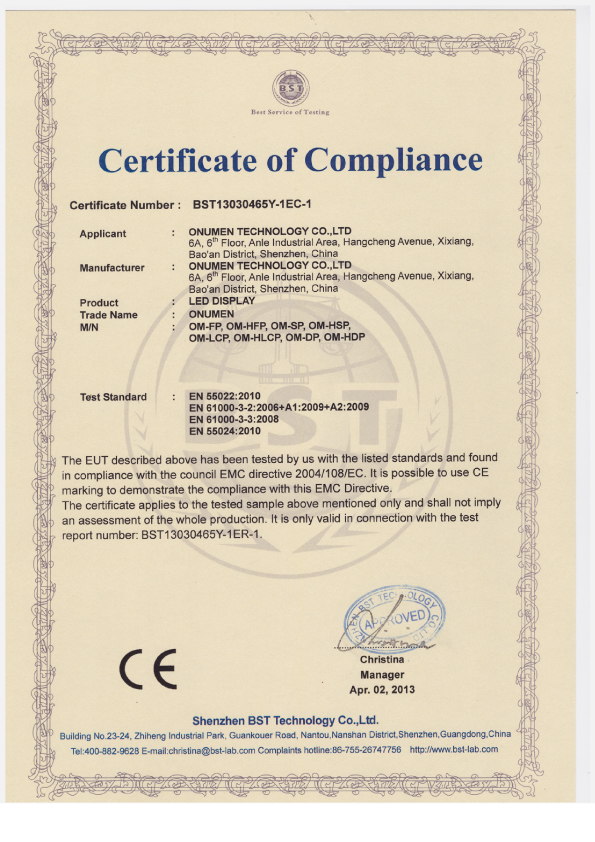
Certificate of Compliance number BST13030465Y-1EC-1, issued by Shenzhen BST Technology Co., Ltd., covers LED Display for the European Union market against EN 55022:2010, EN 61000-3-2:2006+A1:2009+A2:2009, EN 61000-3-3:2008 and EN 55024:2010. The documented issue date is 2 April 2013 with a validity date of 31 December 2099.
For a buyer, this document addresses the emission and immunity behaviour of the display and its power electronics — the part of CE compliance that keeps a screen from interfering with other equipment and from being disturbed by it. On a rental fleet where dozens of screens and radio-linked control systems operate in the same hall, that is not a formality.
EU: CE Low Voltage Directive
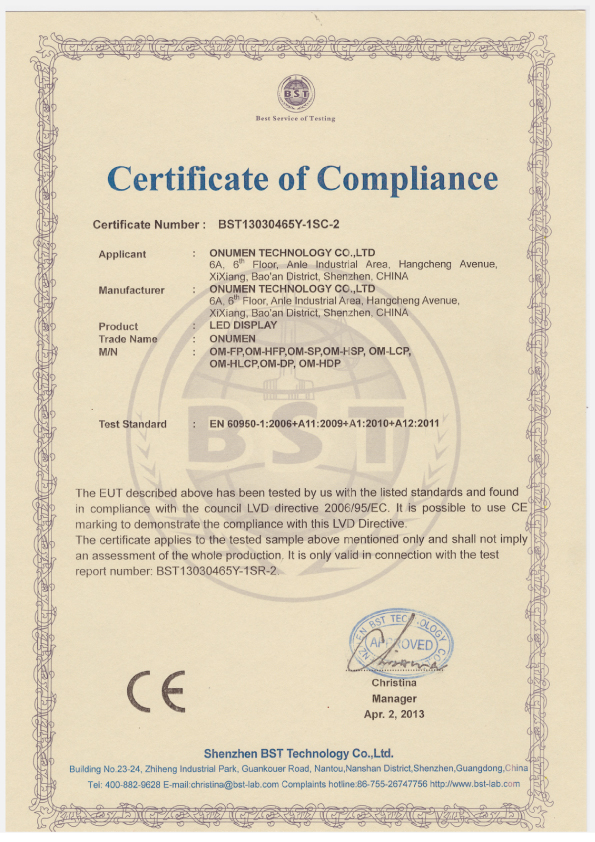
Certificate of Compliance number BST13030465Y-1SC-2, issued by Shenzhen BST Technology Co., Ltd., covers LED Display for the European Union market against EN 60950-1:2006+A11:2009+A1:2010+A12:2011. Documented issue date 2 April 2013, validity date 31 December 2099.
This is the electrical safety layer: protection against electric shock, energy hazards, fire and thermal risk inside the display and its power chain. One practical note for careful buyers — the safety standard family applicable to this product category has since moved toward the IEC, EN and UL 62368-1 generation, so it is reasonable to ask a supplier which standard their current test evidence is issued against for the specific model being purchased.
EU: CE Certificate of Conformity from TUV Rheinland
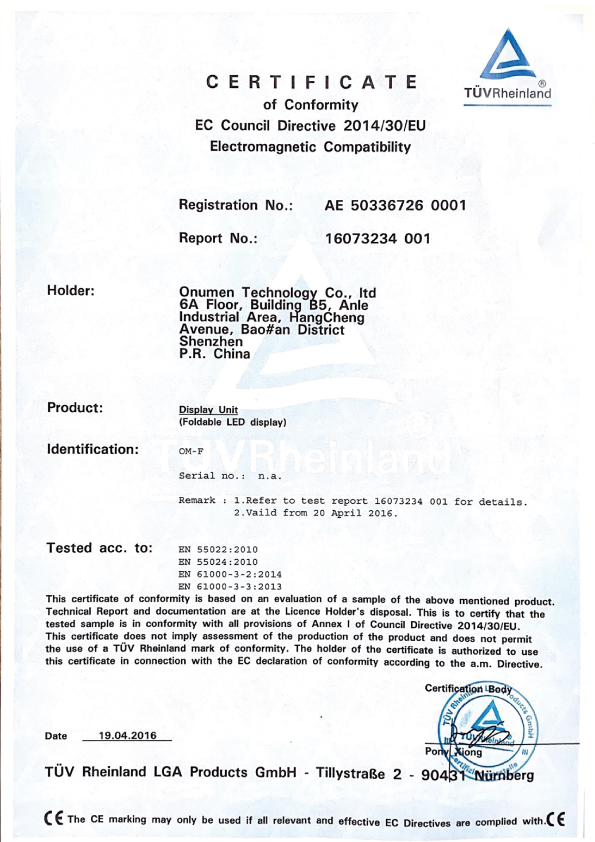
Certificate of Conformity number AE 50336726 0001, issued by TUV Rheinland, covers Foldable LED Display against EN 55022:2010, EN 55024:2010, EN 61000-3-2:2014 and EN 61000-3-3:2013. The documented issue date is 19 April 2016, with a validity date of 31 December 2099.
A certificate of conformity from a European body carries a different weight from a laboratory test report, because the issuing body is itself recognised in the European market. Read the scope wording carefully, however: this certificate names Foldable LED Display. If your order is for a rolling product rather than a folding one, treat it as strong supporting evidence for the technology family rather than as a standalone CE pass for your specific shipment.
EU: RoHS conformity
Two RoHS Certificates of Compliance are documented.
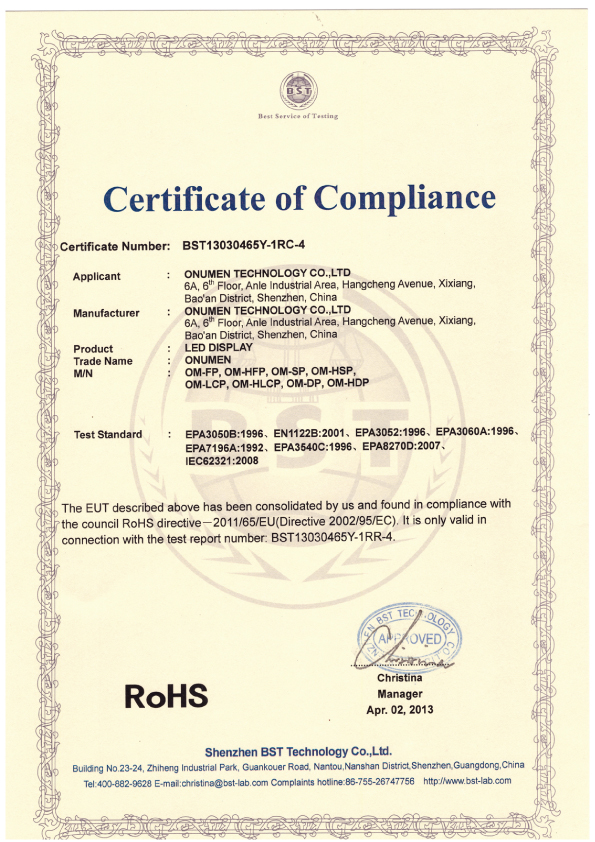
- BST13030465Y-1RC-4, issued by Shenzhen BST Technology Co., Ltd. on 2 April 2013, scope LED Display, assessed against RoHS Directive 2011/65/EU (and Directive 2002/95/EC) and IEC 62321:2008, validity 31 December 2099.
- BST11030273Y-1RC-4, issued by Shenzhen BST Technology Co., Ltd. on 25 March 2011, with the scope listed as LED Display (Model: OM-FCS, OM-FCSH, OM-FCS(LC), OM-FCS(AC), OM-HCD), assessed against EPA 3050B:1996, EN 1122B:2001, EPA 3052:1996, EPA 3060A:1996, EPA 7196A:1992, EPA 3540C:1996 and EPA 8270D:2007 methods, validity 31 December 2099.
The second certificate is the clearest illustration in this article of why scope verification matters. Its recorded scope names five specific model codes. If the purchase order references a different code, that document does not cover the shipment — even though it is genuine, current and issued by an independent laboratory.
Management systems: ISO 14001 and the wider ISO family
Management-system certificates answer a different question from product certificates. They describe how a factory is run rather than what a specific unit does, and they are reissued on a cycle.
Onumen’s Environmental Management System Certification is registered to ISO 14001:2015 under certificate number 95722E0015R0S, issued by Boston Certification on 8 July 2022 with a documented expiry date of 7 July 2025. The recorded scope is the research, development, manufacturing and sales of LED displays.
The company profile states that its production holds ISO management system certificates. Because that profile does not itemise which standards cover which site, a buyer evaluating the factory should request the certificate set directly. That is standard practice rather than a point of suspicion — it is simply the only way to know which standard covers which building.
The two ISO standards most often requested alongside environmental management are ISO 9001 for quality management and ISO 45001 for occupational health and safety. Both are site-level registrations. A buyer sourcing rollable LED screens should ask for the certificate that names the manufacturing site which will actually produce the order, rather than a group-level certificate issued to a different address.

The clock check. Management-system certificates carry an expiry date. Note the number, note the expiry, and request the current certificate before the order is confirmed — not after the container has sailed. This rule applies to every supplier, including the one described in this article.
United States: FCC Part 15
FCC Part 15 governs the radio-frequency behaviour of electronic products placed on the US market. LED displays that contain switching power supplies, receiving cards and control electronics are normally regulated as unintentional radiators, and the applicable authorisation route depends on the device classification and the intended environment — Class A for commercial, industrial and business environments, Class B for residential ones. Where a wireless control module is integrated, that module is typically regulated as an intentional radiator in its own right and carries its own FCC identification.
Onumen product specification sheets list CE, RoHS and FCC among the certifications held across the foldable and rollable range, and the company profile confirms FCC certification among its international product certificates. No FCC identification number is reproduced in this article, because the correct FCC document depends on the specific configuration being shipped. That points to the right question for any buyer to ask: not whether a supplier has FCC, but which FCC document applies to this model in this configuration, and who holds it.
China: CCC (relevant for sourcing and re-export)
CCC certificate number 2021200903000314, issued by CEPREI on 21 October 2021 and documented as valid until 20 October 2026, covers the LED Foldable Display model OM-F rated 100–240 VAC at 50 Hz/60 Hz and 2 A, against GB 4943.1-2011, GB/T 9254-2008 (Class A) and GB 17625.1-2012.
CCC is not a substitute for CE or FCC, and it does not authorise EU or US placement. It is nevertheless useful evidence for buyers sourcing internationally, because it independently confirms the electrical architecture and EMC behaviour of the platform. Note again that the scope names one model, OM-F.
Patents and design awards as supporting evidence
Compliance and innovation are separate questions, but a patent position makes some compliance questions easier to answer. Onumen holds a global patent pool spanning Asia, Europe, the Americas and Oceania. Documented entries include Chinese invention patent ZL202310190465.7 for a Rollable LED Screen and Roll-up LED Display, issued 2 March 2023; Chinese invention patent ZL201010180375.2 for an Automatic Roll-up Flexible LED Curtain Screen, issued 21 May 2010; European patent EP2755459 registered in Belgium, the Netherlands, Germany and France; Taiwanese patent TW I560663; Singaporean patent SG 2014014856; Japanese utility model JP 3199881 and Japanese patent JP 7852969; and Canadian patent CA 2,855,934. The company also holds a Red Dot 2024 award certificate, reference Red 8972, issued 24 June 2024 for a Foldable LED Screen.
The practical value for a buyer is freedom to operate. A protected mechanism reduces the risk that an imported display later becomes the subject of an injunction in the destination market.
Step-by-Step Breakdown: Verifying a Certificate Against a Model Number
Run this sequence in the same order for every supplier you shortlist. It takes less than an hour and it removes most of the risk described above.
- Fix the model code in writing before you ask for documents. Request the series name, the model code and the configuration — indoor or outdoor, pixel pitch, voltage. In Onumen’s range that means identifiers such as FRL/FRSL for the Rolling Rollable LED Display, FCSL for Smart Plus, FTS for Smart T Plus, FC for the Smart folding LED Display screen, FPS for Magic Plus, and EP150–EP225 or EP250–EP400 for the Easy Sailing mobile folding range. A supplier who replies with a brochure instead of a code has already answered your question.
- Ask for the certificate PDF, not a photograph of a logo. A logo on a landing page is a marketing asset. A PDF with a scope field, an issuing body and a validity date is evidence.
- Identify the document type. Test report, certificate of compliance, certificate of conformity, or Declaration of Conformity? Each carries different weight, and the market decides which one you need.
- Read the scope field line by line. Compare it with the model code from step one. If the scope names a different series or a different model list, ask for the correct document rather than accepting a verbal assurance.
- Check the clock. Record the issue date and the expiry date. For product certificates, confirm the design has not changed since issue. For management-system certificates, confirm the certificate is current.
- Check the issuing body. A certificate from a recognised European or international body is a different instrument from one issued by an unknown commercial laboratory.
- Check that the standards cited are the current generation for your market. Standards are revised over time. If a certificate references an older revision of the relevant emission or safety standard, ask what the current test evidence looks like.
- Confirm who signs the EU Declaration of Conformity. Under EU rules the signature must come from an operator established in the EU — the manufacturer’s importer or authorised representative. Ask for the name before you pay.
Applied to the Onumen range, steps three to five produce the following register.
| Document | Reference number | Issuing body | Market | Recorded scope | Issue / validity |
|---|---|---|---|---|---|
| CE EMC Certificate of Compliance | BST13030465Y-1EC-1 | Shenzhen BST Technology Co., Ltd. | European Union | LED Display | 2 Apr 2013 / 31 Dec 2099 |
| CE Low Voltage Certificate of Compliance | BST13030465Y-1SC-2 | Shenzhen BST Technology Co., Ltd. | European Union | LED Display | 2 Apr 2013 / 31 Dec 2099 |
| CE Certificate of Conformity | AE 50336726 0001 | TUV Rheinland | European Union | Foldable LED Display | 19 Apr 2016 / 31 Dec 2099 |
| RoHS Certificate of Compliance | BST13030465Y-1RC-4 | Shenzhen BST Technology Co., Ltd. | European Union | LED Display | 2 Apr 2013 / 31 Dec 2099 |
| RoHS Certificate of Compliance | BST11030273Y-1RC-4 | Shenzhen BST Technology Co., Ltd. | European Union | LED Display, models OM-FCS, OM-FCSH, OM-FCS(LC), OM-FCS(AC), OM-HCD | 25 Mar 2011 / 31 Dec 2099 |
| ISO 14001:2015 Environmental Management System | 95722E0015R0S | Boston Certification | Global | Research, development, manufacturing and sales of LED displays | 8 Jul 2022 / 7 Jul 2025 |
| CCC Certificate | 2021200903000314 | CEPREI | China | LED Foldable Display, model OM-F, 100–240 VAC 50/60 Hz 2 A | 21 Oct 2021 / 20 Oct 2026 |
| Red Dot Award 2024 | Red 8972 | Red Dot Award | Global | Foldable LED Screen | 24 Jun 2024 |
| Chinese invention patent | ZL202310190465.7 | CNIPA | Mainland China | Rollable LED Screen / Roll-up LED Display | 2 Mar 2023 / 2 Mar 2030 |
| European patent | EP2755459 | European Patent Office (registered in Belgium, the Netherlands, Germany and France) | Europe | Freely-foldable flexible LED screen | 30 Nov 2016 (DE/FR), 2 Feb 2017 (NL), 15 Feb 2017 (BE) |
Use Cases: Where Compliance Documentation Actually Gets Tested
EU touring and rental at stadium scale
A European stage production company specifying a 100+ m² liftable foldable LED display for a stadium-scale concert carries a compliance file the way it carries spare panels. Onumen’s liftable foldable display was integrated into the concert stage structure at Stade de France, enabling dynamic lifting and folding movements during the performance, with the installation documented as running for more than two years. On a tour that crosses borders, the CE EMC and Low Voltage evidence has to travel with the equipment manifest, because a national inspector can stop the load at any point.
US fixed installation in a commercial interior
A hotel ballroom, corporate showroom or conference centre in the United States is normally a Class A environment for FCC purposes, which simplifies the radio-frequency picture. The electrical picture is different: the authority having jurisdiction may require an NRTL listing such as UL 62368-1, and local electrical codes govern the supply and disconnect arrangement. Buyers should raise this at specification stage, because retrofitting a listing after installation costs far more than specifying it correctly at the outset.
Outdoor advertising on a building or mall frontage
Outdoor configurations raise both ingress-protection and safety questions. In the Rolling Rollable LED Display FRL/FRSL range, outdoor units are documented at front IP65 and rear IP65, while indoor units are documented at front IP54 and rear IP43. Those figures belong in the specification conversation, not in a marketing summary, because they determine whether the enclosure can be certified for the position your client has in mind.
Airports, transit and public venues
Public venues add photobiological safety to the list. IEC 62471 addresses blue-light hazard and is a required consideration for LED products in the EU and China. Venue operators increasingly ask for it alongside the electrical documentation, and the question usually arrives from a health and safety officer rather than a procurement manager.
Portable and quick-assembly deployments
Fast-deploy screens are the easiest category for a compliance shortcut to hide, because the sale is often made on setup speed. The documentation requirements are identical to those for a fixed installation. Buyers specifying portable quick-assembly rollable LED screens should insist on the same certificate set and the same model-code scope check they would apply to a permanent wall.
EU versus US: which requirement sits where
| Topic | European Union | United States |
|---|---|---|
| Electromagnetic compatibility | CE EMC evidence, for example certificate BST13030465Y-1EC-1 | FCC Part 15 authorisation for unintentional radiators |
| Electrical product safety | CE Low Voltage evidence, for example certificate BST13030465Y-1SC-2 | NRTL listing to UL 62368-1 where required by the authority having jurisdiction |
| Fire performance of materials | Flame-retardant material selection recorded in the technical file | UL 94 V-0 commonly specified for public-space installations |
| Restricted substances | RoHS Directive 2011/65/EU, for example certificate BST13030465Y-1RC-4 | Contractual restricted-substance requirements and applicable state rules |
| Management systems | ISO 9001, ISO 14001, ISO 45001 | ISO 9001, ISO 14001, ISO 45001 |
| Who carries legal responsibility | An economic operator established in the EU | The importer of record |
Frequently Asked Questions
Which certificates should an importer verify before bringing a rollable LED screen into the EU or the US?
For the European Union, verify CE EMC evidence, CE Low Voltage evidence, RoHS conformity and a Declaration of Conformity signed by an operator established in the EU. For the United States, verify the FCC Part 15 authorisation that applies to the control configuration being shipped and, where the installation falls under local electrical codes, the NRTL listing your authority having jurisdiction recognises. In both markets, confirm that each document’s recorded scope covers the exact model code on your purchase order. Onumen’s rollable and foldable range carries documented CE EMC certificate BST13030465Y-1EC-1, CE Low Voltage certificate BST13030465Y-1SC-2, CE Certificate of Conformity AE 50336726 0001 issued by TUV Rheinland, and RoHS certificate BST13030465Y-1RC-4, with FCC listed among the product certifications across the range.
Do these certificate numbers cover every rollable LED model, or only specific ones?
Each certificate covers a defined scope rather than the entire catalogue. RoHS certificate BST11030273Y-1RC-4 records its scope as LED Display with the model list OM-FCS, OM-FCSH, OM-FCS(LC), OM-FCS(AC) and OM-HCD. CCC certificate 2021200903000314 names a single model, OM-F. CE Certificate of Conformity AE 50336726 0001 records its scope as Foldable LED Display. Buyers should match the scope wording against the model code on the purchase order and, where it does not match, request the specific document for that model before confirming the order.
Can a rollable LED screen be customised for portable quick-assembly use while keeping its compliance evidence valid?
Onumen provides customizable production services covering screen size, pixel pitch, cabinet design, installation structure, control system, logo and packaging, with a minimum order quantity of 1 m² or 1 unit and a lead time of 30 to 90 days after order confirmation. Documented monthly capacity is 3,000 to 5,000 m². One compliance consequence deserves attention: where a customisation changes the electrical configuration, the enclosure or the control system, the existing test evidence may no longer describe the delivered product, so the supplier should confirm in writing which documents remain applicable to the customised build.
How is acceptance testing handled, and can a buyer inspect the product before shipment?
Acceptance procedures include pre-shipment inspection, video inspection and functional testing before delivery, and quality control is documented as a 100% aging test and quality inspection before shipment. A buyer importing into the EU or the US should combine that with a final check that the model code on the shipping documents matches the model code on the certificate scope. Where the two do not match, resolve it before the container leaves, not after.
What are the purchasing terms, and what is the next step for a buyer with a compliance requirement?
Purchasing terms are documented as a minimum order quantity of 1 m² or 1 unit, delivery terms of EXW, FOB, CIF and DDP with international shipping support, and payment terms of T/T, L/C and Trade Assurance where applicable, on a lead time of 30 to 90 days after order confirmation. The next step is to send the sales team your model code, destination market and installation type at sales@onumen.com, or through www.onumen.com, so the certificate set can be matched to the exact configuration before the order is confirmed.
Conclusion: Compliance Is a Scope Question, Not a Logo Question
Rollable LED screens are imported successfully into the EU and the US every week, and the difference between a smooth clearance and a stalled container is rarely the technology. It is whether somebody checked, in writing, that each certificate covers the model in the crate.
The practical sequence is short. Identify the model code. Collect the certificate PDFs. Read the scope field. Check the validity dates. Confirm who signs the Declaration of Conformity. Then repeat the process for the next model, because a supplier’s certificate file is organised per model, not per brand.
Onumen Technology Co., Ltd. documents CE EMC, CE Low Voltage, CE Certificate of Conformity, RoHS, ISO management system, CCC and design award registrations, together with a patent pool spanning Asia, Europe, the Americas and Oceania. Every reference number in this article can be checked against the original documents, and that is precisely the intent: a compliance guide that cannot be verified is not a compliance guide.
Request the certificate set for your model
Send Onumen your model code, destination market and installation type, and we will return the matching certificate documents — scope, issuing body and validity dates included — so that your compliance file is complete before the order is confirmed.
Web: www.onumen.com | Email: sales@onumen.com | Tel: +86 755 8360 1688
Have Questions or Need More Details?
Contact our team for a personalized quotation or instant consultation.
Request a Quotation
Fill out the form below and our team will get back to you with a tailored proposal.
WhatsApp Direct Chat
Prefer to chat in real-time? Message us on WhatsApp for instant assistance & quick answers.
- Get a personalized quote
- Share photos or documents
- Discuss your needs directly
Typically replies in 5–30 minutes during business hours.