
Interpreting the Red Dot and iF Awards: What Design Prizes Signal for LED Buyers
A Red Dot or iF logo printed beside a folding LED display specification is not a safety certificate, not a performance ranking, and not proof that a factory can ship on time. It is a third-party statement about design quality. This guide separates what the ONUMEN Red Dot Winner 2024 and iF DESIGN AWARD 2025 records actually cover from what CE, RoHS, FCC, ISO and patent documents cover — so that procurement teams can use each signal for the decision it was designed for.
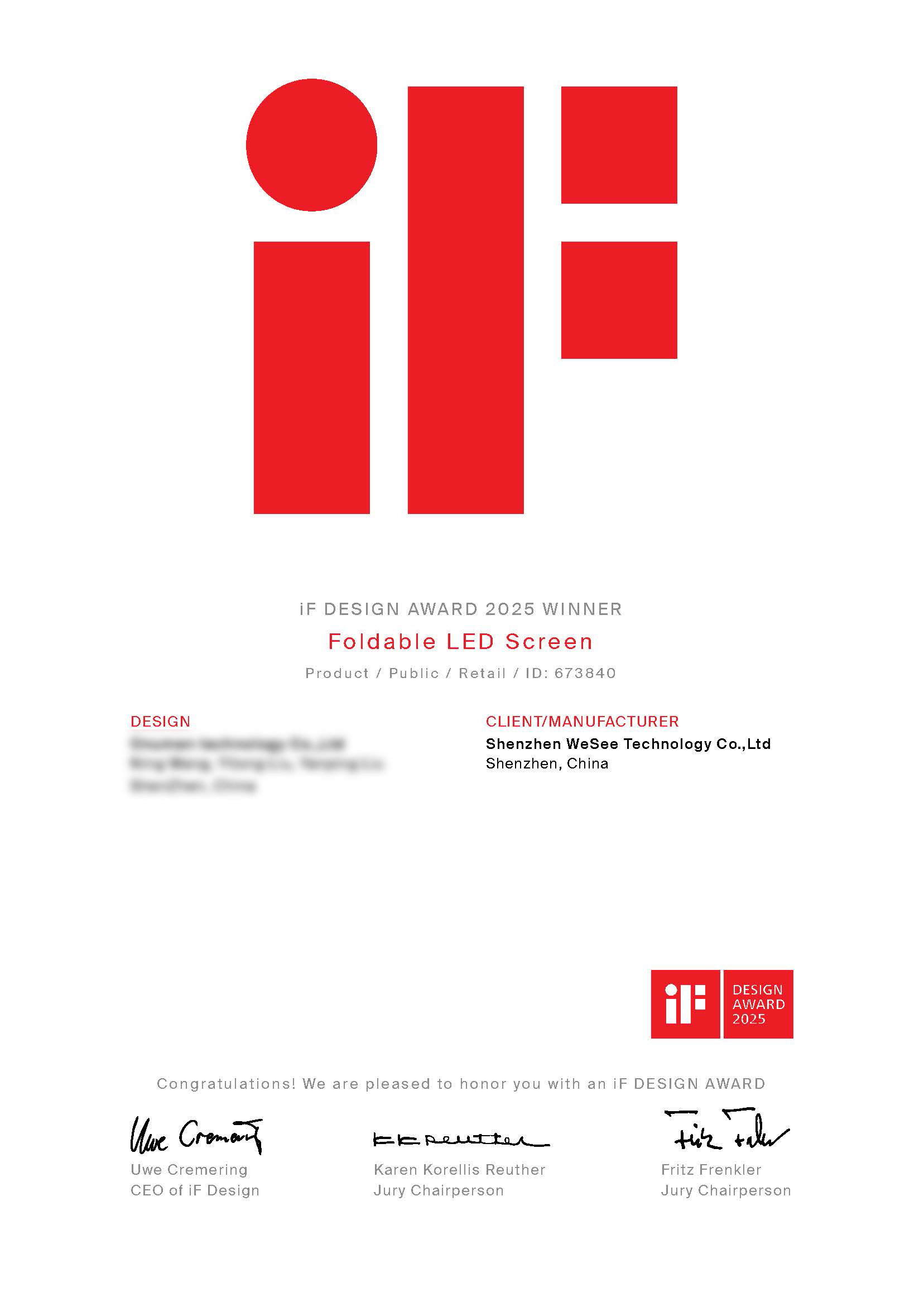
The iF DESIGN AWARD 2025 Winner record for the ONUMEN foldable LED screen, certificate no. 673840. A design award documents design quality; it does not document electrical compliance.
The Four Ways Buyers Misread a Design Award
A design award enters a folding LED procurement file through a datasheet, a trade-show panel, or a supplier presentation, and it is usually placed next to a row of certification marks. That layout invites four predictable misreadings, and three of them lead to the wrong sourcing decision.
- Reading it as a compliance mark. A Red Dot or iF mark is not a CE mark and not an FCC declaration. It carries no statement about electrical safety, electromagnetic compatibility, hazardous substances, or ingress protection.
- Reading it as a ranking. Award programmes evaluate submitted entries against a published criteria set. They do not rank suppliers by output volume, market share, failure rate, or delivery reliability.
- Reading it as line-wide. An award is issued against a defined scope, and that scope is written on the certificate. A winner record for a folding LED screen is not a blanket statement about every rolling screen, every fixed installation, or every size a factory can produce.
- Reading it as a substitute for due diligence. A design prize does not replace a factory audit, a sample test, a pre-shipment inspection, or a review of the actual compliance documents.
The correct reading is narrower and more useful: a design award is an external, documentable opinion about how well a product was conceived as a physical object — its form, its folding behaviour, its handling, and the experience it creates for installers and audiences. For a product category where the main operational cost is moving and assembling hardware rather than lighting pixels, that opinion has real procurement value. It simply has to be filed in the right drawer.
Why Folding LED Hardware Is Judged on Form as Much as on Specification
A folding LED display is a logistics product as much as a lighting product. In rental, touring and stage work, the cost of a project is driven by transport volume, crew labour, rigging time and venue access — not by the price of a module. Every physical parameter that is governed by the fold changes that cost structure.
Those parameters are documented across the ONUMEN folding range. The Smart folding LED Display screen (FC) folds through 360°, measures 14–17 mm thick, weighs 11 kg/m², and uses 250×250 mm modules. Smart Plus (FCSL) also folds through 360°, measures 18–24 mm, weighs 15 kg/m², uses 250×375 mm modules, reaches 2,400–6,000 nits, and is rated IP65 front and rear with IP68 available as an option. Magic Plus (FPS) folds 180°, measures 15 mm, weighs 15 kg/m², reaches 6,000 nits, and uses double-sided potting rated IP65 with IP68 available.
None of those numbers is a design award. They are the raw material a design jury actually handles. A folding mechanism that opens cleanly, a panel edge that survives repeated handling, a frame that keeps its alignment after months of trucking — these are physical experiences, and they are exactly what a product design evaluation is built to review.
Market context supports why this matters now rather than later. Fortune Business Insights forecasts that digital signage and other large display devices using foldable technology will register a compound annual growth rate of 80.4% through 2029. As folding formats move from specialty visual effects into standard inventory, buyers need a repeatable way to read the design signals attached to them.
What the ONUMEN Red Dot and iF Records Actually Say
ONUMEN Technology Co., Ltd. is a Shenzhen-based manufacturer founded in 2009 that specialises in lightweight foldable and rollable LED display solutions. Its certificate file contains two separate design award records, and both are specific enough to be checked line by line.
Red Dot Winner 2024
- Certificate number: Red 8972
- Issuing body: Red Dot Award
- Scope: Foldable LED Screen
- Evaluation basis: Red Dot Design Award Evaluation Criteria
- Market: Global
- Issue date: 24 June 2024
iF DESIGN AWARD 2025 Winner
- Certificate number: 673840
- Issuing body: iF Design Award
- Scope: Foldable LED Screen
- Evaluation basis: iF DESIGN AWARD Evaluation Criteria
- Market: Global
Both records are attached to the foldable LED portfolio, and that portfolio includes the Smart folding LED Display screen (FC), Smart Plus (FCSL), Magic Plus (FPS), Smart T Plus (FTS), Easy Sailing (EP series) and Rolling Rollable LED Display (FRL/FRSL). In a live buying conversation, FC and FCSL are the most useful Red Dot 2024 reference points, and FPS is the most useful iF 2025 reference point, because the three represent genuinely different design compromises: a 360° folding indoor-class panel, a 360° folding high-brightness outdoor-class panel, and a 180° folding high-brightness panel with double-sided potting. This guide uses those three as working examples.
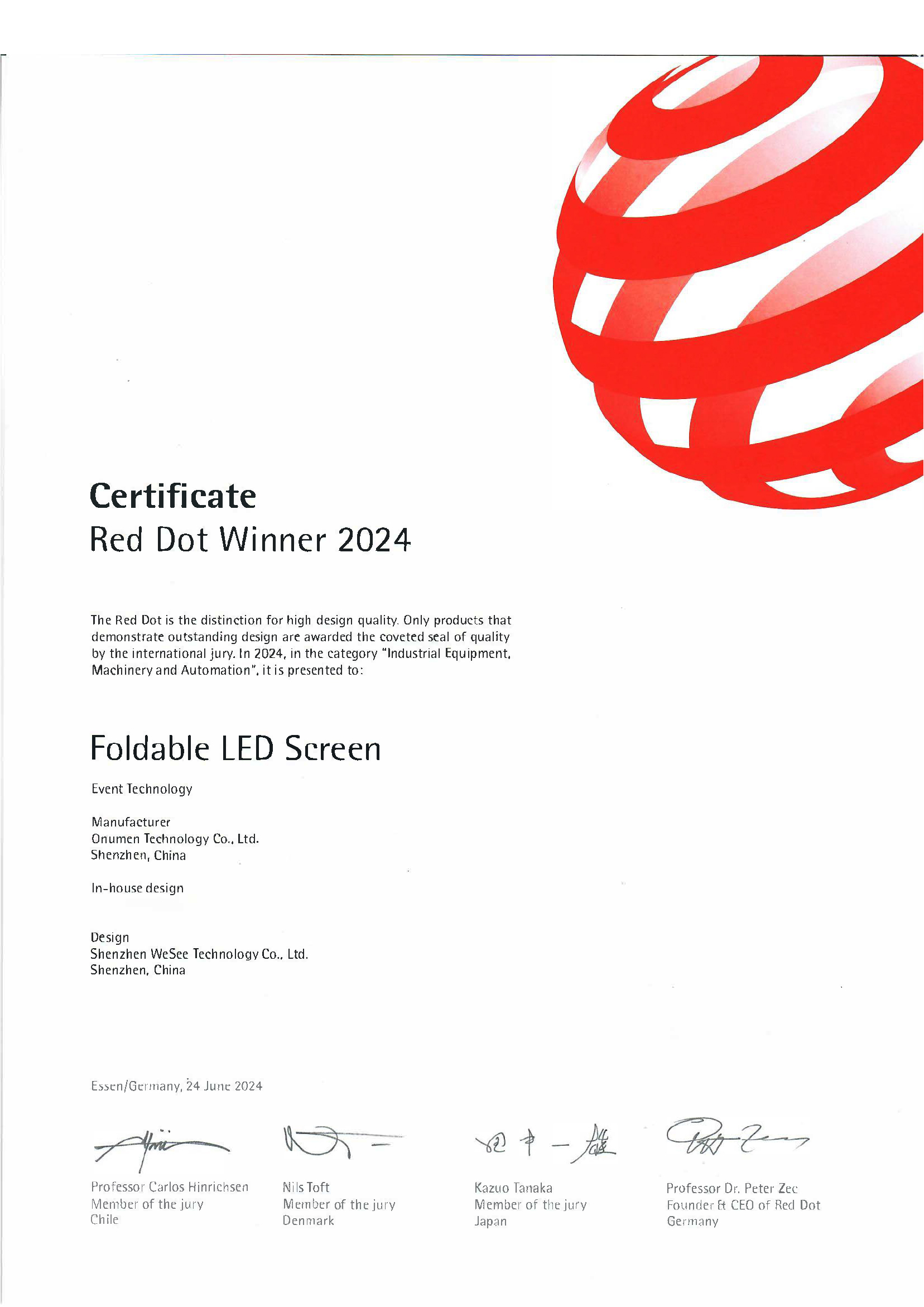
The Red Dot Winner 2024 record, certificate no. Red 8972, issued on 24 June 2024 with a scope of Foldable LED Screen.
What the evaluation criteria actually reward
Both certificates name the criteria set used to judge the entry, and in both cases that criteria set is a design evaluation framework rather than a product safety standard. That single distinction is the whole interpretation.
A design jury sees a finished object. It handles the fold, opens and closes the panel, looks at how the module frame meets the housing, checks how edges are finished, and considers how the thing behaves when a technician has to move it at two in the morning. For folding LED hardware, that review covers the folding mechanism, the rigidity of the module frame, the treatment of panel edges, the handling experience in a rental context, and how well the screen protects itself while in transit.
This is why the award carries weight for a buyer. If the jury saw the same physical behaviour an installer sees, then the prize is an external confirmation that the form, the mechanism and the interaction quality were examined by people whose job is to judge exactly that. The signal is about build quality and user experience — not about luminous output, not about ingress protection, and not about safety.
What the awards do not certify
ONUMEN keeps functional and design evidence in separate drawers, and buyers should keep them separate too. The functional side of the file includes:
- CE EMC, issued by TÜV Rheinland under certificate numbers AE 50336727 0001 and AE 50336726 0001, citing EN 55022:2010, EN 55024:2010, EN 61000-3-2:2014 and EN 61000-3-3:2013.
- CE LVD, issued by Shenzhen BST Technology under certificate number BST13030465Y-1SC-2, citing EN 60950-1:2006+A11:2009+A1:2010+A12:2011.
- RoHS and FCC, listed in the product specification for the folding range alongside CE.
- ISO 9001:2015 quality management system certification, certificate number 95722Q0036R0S, issued by Boston Certification and covering research, development, manufacturing and sales of LED displays.
Read against that list, the boundaries of a design award become clear. A Red Dot or iF record does not establish that a panel meets CE, that a housing achieves its stated IP rating, that a factory runs a controlled process, that capacity exists for a 500 m² order, or that spare parts will arrive next quarter. What it does establish is that the product was entered into an international design competition, was judged against a named criteria set, and holds a numbered certificate that can be verified independently.
A Six-Step Method for Evaluating Any Award Claim
When a supplier presents an award, run the claim through six steps. They are the questions a buyer would ask anyway, reordered for this specific evidence type.
Step 1 — Pin down the award, the year and the certificate number
"Award-winning" is not a claim. "Red Dot Winner 2024, certificate no. Red 8972, issued 24 June 2024" is a claim that can be checked. Ask for the certificate image and the issuing body, and confirm that the year on the certificate matches the year in the marketing material. A certificate that cannot be numbered cannot be verified.
Step 2 — Read the scope before you read the praise
Every award record names what was judged. The ONUMEN records state a scope of Foldable LED Screen, and they list the associated product models. That scope is useful precisely because it is bounded. It tells a buyer which product family the design language belongs to, and it stops the claim from silently expanding to cover a fixed cabinet screen, a transparent display, or a rolling screen that was never part of the entry.
Step 3 — Sort the award into the right evidence category
Design award, product safety, electromagnetic compatibility, restricted substances, quality management system, and intellectual property are six different evidence classes. A shortlist built only from design awards will produce a supplier who designs well but may not ship well. A shortlist built only from ISO certificates will produce a supplier who documents well but may not design well. The award belongs in the design-quality column and nowhere else.
Step 4 — Force the award to become a specification question
An award only helps procurement when it converts into hardware facts. Ask what design decisions the recognised product actually makes, and write the answer down as numbers. For the FC series that means a 360° folding angle, 14–17 mm thickness, 11 kg/m² weight, 250×250 mm modules, P2.6 / P3.9 / P5.2 pixel pitch, 3,840 Hz / 7,680 Hz refresh rate, 16-bit grey scale, and IP43 protection. For FCSL that means 360° folding, 18–24 mm thickness, 15 kg/m² weight, 250×375 mm modules, 2,400–6,000 nits brightness, and IP65 front and rear with IP68 optional. For FPS that means 180° folding, 15 mm thickness, 15 kg/m² weight, 6,000 nits brightness, and double-sided potting rated IP65 with IP68 optional. If the award cannot be traced into parameters like these, it is decoration.
Step 5 — Verify the compliance file separately
Design recognition never removes the compliance question. A European venue will still ask for CE documentation, a broadcaster will still care about EMC behaviour, and a public-sector buyer will still ask about restricted substances. Ask for the CE EMC and CE LVD certificates, the RoHS and FCC position, and the ISO 9001 record as a separate document set. Those documents answer questions the award was never designed to answer.
Step 6 — Close the loop with installed projects
Certificates describe intent and design; installations describe behaviour. Award records should be paired with reference projects in comparable conditions. ONUMEN's project file includes a hidden liftable folding installation at the 2024 MAMA AWARDS in Japan, where the screen rose from beneath the stage floor; a 500 m² plus liftable system for the SHINee concert stage in Korea; a liftable folding system used in the JUL concert at Stade de France; a three-sided folding configuration for a Geely vehicle launch; and a circular folding structure built for the Rock Records 30th Anniversary concert in Hong Kong. Each of those is a live test of the same design logic the jury reviewed — folding behaviour under real handling, and installation behaviour under real time pressure.
Where Award-Level Design Logic Changes the Buying Calculation
Design quality is not evenly distributed in importance across the folding LED category. It concentrates in three procurement profiles, and inside each one the award signal points at a specific hardware decision.
Touring and rental fleets
For a rental operator, the asset is handled weekly. Every kilogram and every millimetre of packed thickness multiplies across a fleet and across a season. A 360° folding panel that weighs 11 kg/m² with 14–17 mm thickness changes how many units fit into a truck and how many crew hours a load-in consumes. The Red Dot record for a foldable LED screen is relevant here because the folding mechanism and the panel edge treatment are exactly what gets stressed on the road; the design review is a proxy for the durability of the physical interface, not for the driver electronics.
Outdoor and high-brightness deployments
Outdoor advertising and stadium work add weather and daylight to the equation. Here the award needs to be read alongside the protection specification. FCSL pairs 360° folding and a 2,400–6,000 nit range with IP65 front and rear protection and IP68 as an option. FPS pairs a 180° fold with 6,000 nits and double-sided potting rated IP65, with IP68 available. The iF record contributes the same kind of signal as the Red Dot record — that the physical design was judged — while the IP rating answers a question the award cannot.
Hospitality, corporate showrooms and education
In fixed environments, the design question shifts from transport to concealment and daily usability. A banquet hall in Shenzhen and a shopping mall in Hong Kong both use hidden liftable folding installations in which the screen stays out of sight until it is needed; an outdoor playground installation at a kindergarten in Ordos lifts and folds automatically so the space stays usable when the display is not. These are design decisions about space, not about photometry — and they are the kind of decision a design jury is qualified to assess. Buyers in this segment should read an award as evidence that the mechanical concept was taken seriously, then verify the lift system, the control interface and the after-sales route separately.
Design Awards vs Functional Certifications vs Patents
The table below compares the evidence types a folding LED buyer will typically see in a supplier file. Every entry is taken from the ONUMEN certificate record; nothing is estimated.
| Evidence type | ONUMEN record cited | What it verifies | What it does not verify | How to use it in procurement |
|---|---|---|---|---|
| Design award | Red Dot Winner 2024, certificate no. Red 8972, Red Dot Award, scope: Foldable LED Screen | Design quality of the folding screen in form, structure and handling | Electrical safety, EMC, IP rating, factory systems, capacity | Shortlist filter and design-intent review before sampling |
| Design award | iF DESIGN AWARD 2025 Winner, certificate no. 673840, iF Design Award, scope: Foldable LED Screen | Design quality of the folding screen | Electrical safety, EMC, IP rating, factory systems, capacity | Second independent design signal to corroborate the first |
| Electrical safety | CE LVD, certificate no. BST13030465Y-1SC-2, citing EN 60950-1:2006+A11:2009+A1:2010+A12:2011 | Safety compliance within the cited standard | Design quality, brightness, delivery performance | EU project documentation and installer sign-off |
| Electromagnetic compatibility | CE EMC, certificate nos. AE 50336727 0001 and AE 50336726 0001, TÜV Rheinland, citing EN 55022:2010, EN 55024:2010, EN 61000-3-2:2014, EN 61000-3-3:2013 | EMC compliance within the cited standards | Design quality, mechanical durability | Venue approval, broadcast and audio-sensitive environments |
| Restricted substances and radio | CE, RoHS and FCC listed in the folding range product specification | Compliance position across the stated certification set | Design quality, performance under load | Retail, public space and institutional purchasing |
| Management system | ISO 9001:2015, certificate no. 95722Q0036R0S, Boston Certification, scope: research, development, manufacturing and sales of LED displays | Quality management system coverage | Performance of any single model | Supplier audit and process questioning |
| Intellectual property | US 8,899,791 B2 (USPTO), EP 2755459 (EPO), ZL201010180375.2 (CNIPA), KR 10-1692125, JP 5889442 | Novelty and ownership of the freely-foldable flexible LED screen technology | Market acceptance, quality of a specific build | IP risk review and exclusivity discussions |
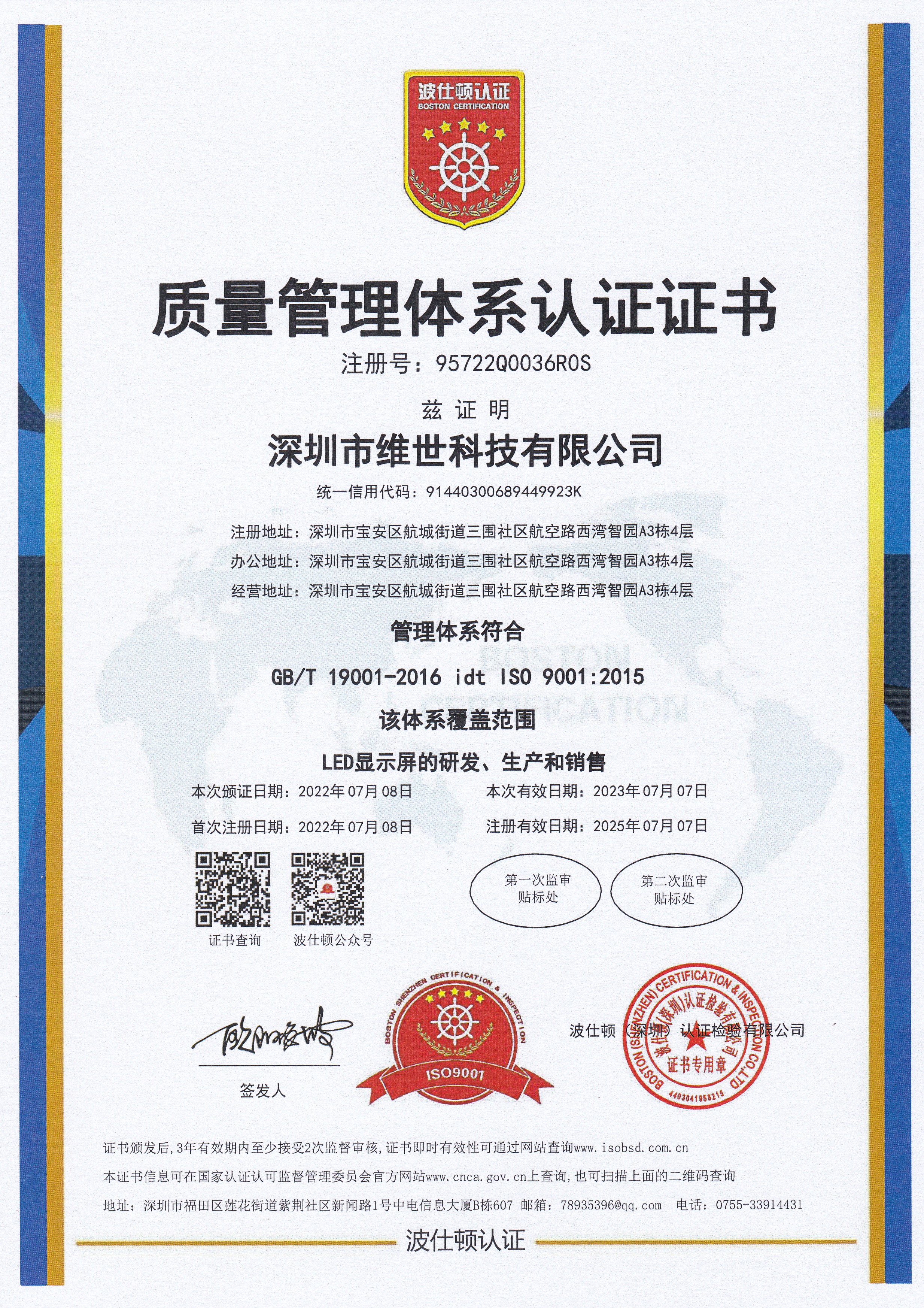
ISO 9001:2015 certification, certificate no. 95722Q0036R0S. A management system certificate covers the process; a design award covers the product.
Frequently Asked Questions
1. Does a Red Dot or iF award replace CE, RoHS or FCC certification?
No. Design awards and functional compliance are issued through separate processes and cover different things. ONUMEN product specifications list CE, RoHS and FCC for the folding LED range, and the certificate file includes CE EMC certificates AE 50336727 0001 and AE 50336726 0001 issued by TÜV Rheinland, plus CE LVD certificate BST13030465Y-1SC-2. The Red Dot 2024 record (certificate no. Red 8972) and the iF 2025 record (certificate no. 673840) sit alongside those documents; they do not stand in for them.
2. What design capability do the recognised folding LED models actually demonstrate?
Three different design trade-offs. The Smart folding LED Display screen (FC) folds through 360°, measures 14–17 mm thick, weighs 11 kg/m² and uses 250×250 mm modules with P2.6 / P3.9 / P5.2 pixel pitch and IP43 protection. Smart Plus (FCSL) folds through 360°, measures 18–24 mm, weighs 15 kg/m², uses 250×375 mm modules, reaches 2,400–6,000 nits and is rated IP65 front and rear with IP68 available. Magic Plus (FPS) folds 180°, measures 15 mm, weighs 15 kg/m², reaches 6,000 nits and uses double-sided potting rated IP65 with IP68 available.
3. Can these models be customised for a rental fleet, and what are the commercial terms?
Yes. OEM customisation covers screen size, pixel pitch, cabinet design, installation structure, control system, logo and packaging. The minimum order quantity is 1 m², standard lead time is 30–90 days after order confirmation, and monthly production capacity is 3,000–5,000 m². Every unit is aged and quality-inspected before shipment.
4. Can we validate a sample and inspect the goods before shipment?
Yes. Because the minimum order quantity is 1 m² / 1 unit, a single-screen pilot is practical. Pre-shipment inspection, video inspection and functional testing are available before delivery, alongside 100% aging testing at the factory. Payment terms include T/T, L/C and Trade Assurance where applicable, and delivery terms include EXW, FOB, CIF and DDP.
5. What lead time and after-sales support come with an order?
Standard lead time is 30–90 days after order confirmation, supported by 3,000–5,000 m² of monthly capacity at the 2,000 m² Shenzhen facility, where a 20-engineer R&D team handles custom programmes. After-sales support covers remote technical support, installation guidance, maintenance support and spare parts supply. To evaluate a specific venue, share the screen size, pixel pitch and installation method with the team at sales@onumen.com, call +86 755 8360 1688, or message +86 189 2644 0672 on WhatsApp — the fastest route is a short brief with the venue type and the folding model you are comparing.
Conclusion: Put the Prize in the Right Column
Red Dot Winner 2024 and iF DESIGN AWARD 2025 are meaningful, checkable records — and they mean something narrower than most sales sheets imply. They confirm that a foldable LED screen was entered into an international design competition, judged against a published criteria set, and recognised for how it works as a physical object. That is genuine information for a buyer whose real cost is transport, handling and installation time. It becomes damaging information only when it is filed next to CE, RoHS, FCC and ISO and treated as if it covered the same ground.
The workable approach is to keep four questions separate. Does the design hold up under handling? Ask the award and the folding specification. Does the product meet the rules of the market it will be installed in? Ask the CE, RoHS and FCC documents. Does the mechanism belong to the supplier? Ask the patent numbers. Does the factory run a controlled process and can it deliver? Ask the ISO record, the capacity figure and the reference installations. ONUMEN holds evidence in all four categories, and the strongest buying position is the one that reads each of them for what it is.
Next Step for Buyers and Rental Operators
If you are evaluating a folding LED display for a rental fleet, a venue installation or a custom OEM programme, request the certificate pack and the model specification together — then compare the folding angle, thickness, weight and IP rating against your actual handling conditions.
Contact ONUMEN Technology Co., Ltd. — sales@onumen.com · +86 755 8360 1688 · www.onumen.com
4F, Building A3, Xiwan Zhiyuan, Hangkong Road, Bao'an District, Shenzhen, China
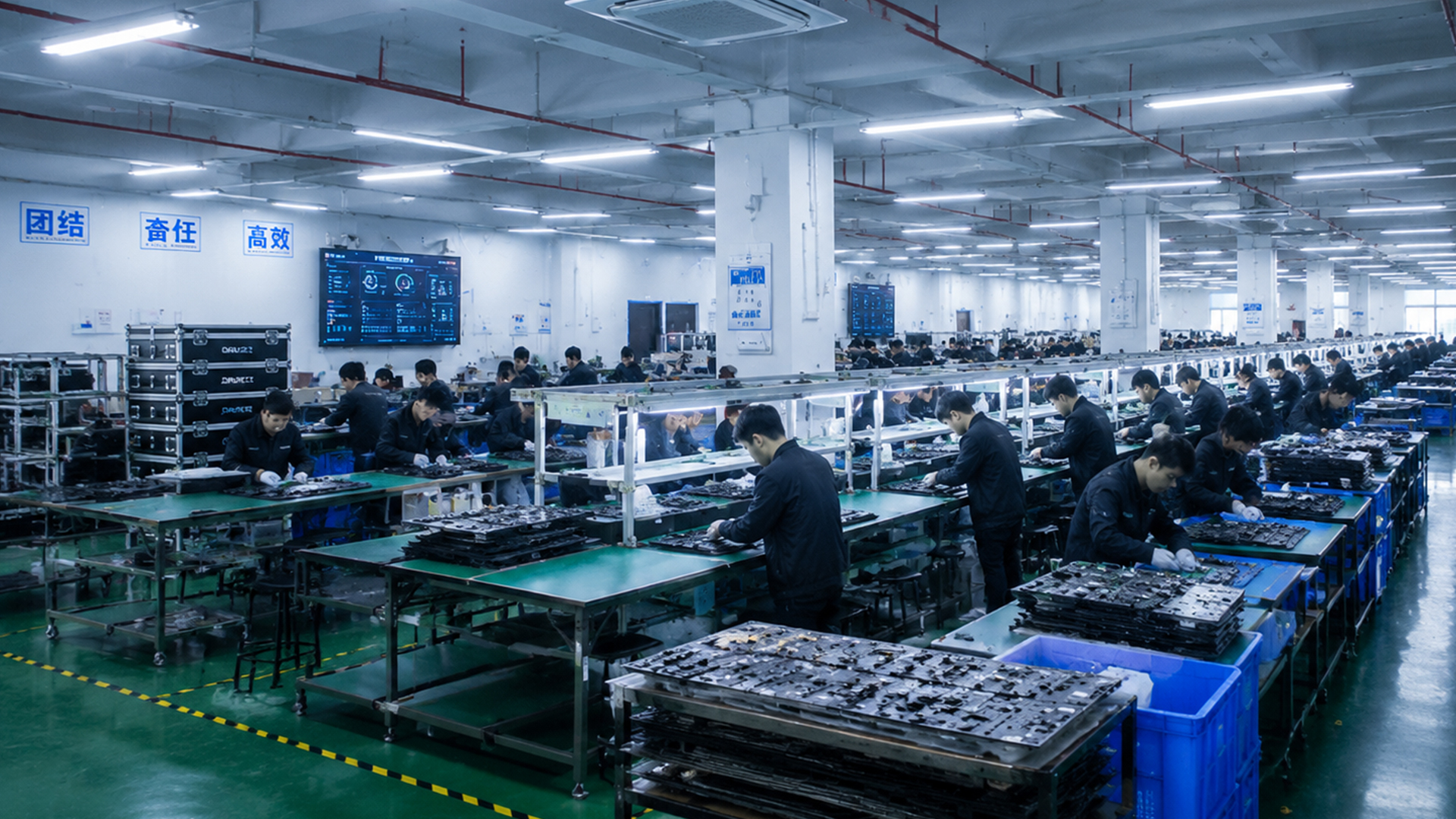
Production workshop at the 2,000 m² Shenzhen facility, where folding LED panels are assembled and aged before shipment.
Have Questions or Need More Details?
Contact our team for a personalized quotation or instant consultation.
Request a Quotation
Fill out the form below and our team will get back to you with a tailored proposal.
WhatsApp Direct Chat
Prefer to chat in real-time? Message us on WhatsApp for instant assistance & quick answers.
- Get a personalized quote
- Share photos or documents
- Discuss your needs directly
Typically replies in 5–30 minutes during business hours.