
Rolling vs. Smart Folding LED Display: A Buyer's Head-to-Head Guide
Rolling Rollable LED Display vs. Smart Folding LED Display: A Buyer's Head-to-Head Guide
Two lightweight LED formats now sit side by side in the same tender: the Rolling Rollable LED Display (FRL/FRSL) and the Smart Folding LED Display (FC). They both remove the heavy cabinet, both ship in far less volume than a traditional wall, and both can be installed by a small crew. The difference that decides a project is not which one looks more advanced. It is how the panel is stored between shows, what the venue demands on install day, and which compliance file your buyer, venue or customs broker needs to see.
Decision summary.
- Choose the rolling format (FRL/FRSL) when the panel is deployed repeatedly in a fixed or near-fixed configuration and storage space is the binding constraint, and when your compliance file must satisfy EU low-voltage, FCC and RoHS review alongside ISO 9001:2015 and ISO 14001:2015 management-system checks.
- Choose the smart folding format (FC) when the same screen must be set up and struck frequently across different venues, and when the evaluation includes CE EMC and RoHS, FCC Part 15 Subpart B, ISO 9001:2015 and ISO 45001:2018, plus a verifiable design record such as the iF DESIGN AWARD 2025 and Red Dot Winner 2024.
- Never decide on unit price alone. Compare storage volume, labour per install, transport cost and the acceptance evidence the supplier will hand over before shipment.
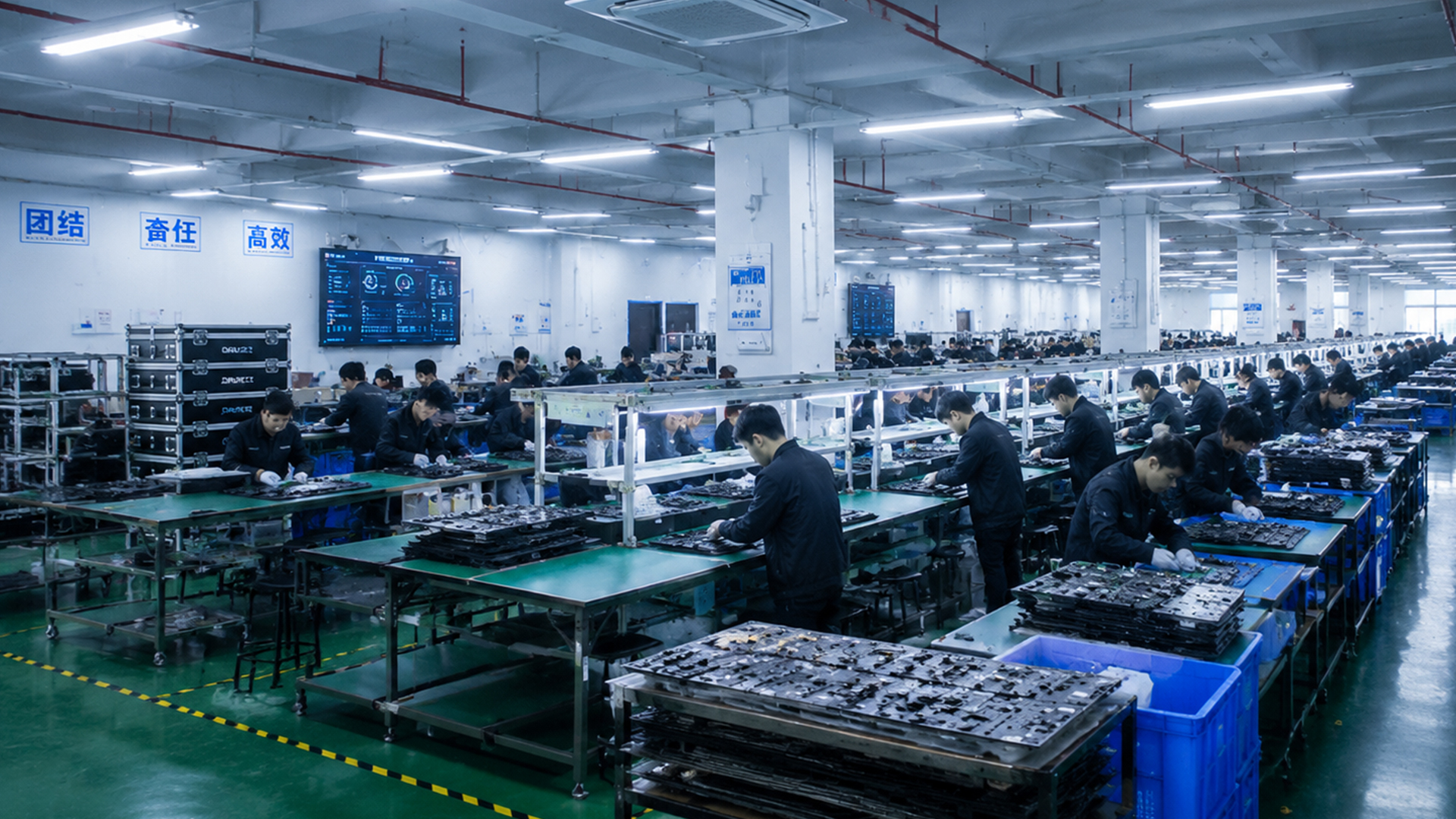
This guide is written for buyers at the decision stage, so it assumes you already know what a flexible LED panel is and are now separating two shortlisted formats. Both products referenced here are made by Onumen Technology Co., Ltd., a Shenzhen-based manufacturer founded in 2009 that produces lightweight foldable and rollable LED display solutions, operates a 2000㎡ factory with a 20-engineer R&D team, and exports roughly 70% of its output to the USA, Europe, Japan, South Korea, Russia and the Middle East.
The decision problem: two mechanical answers to the same weight problem
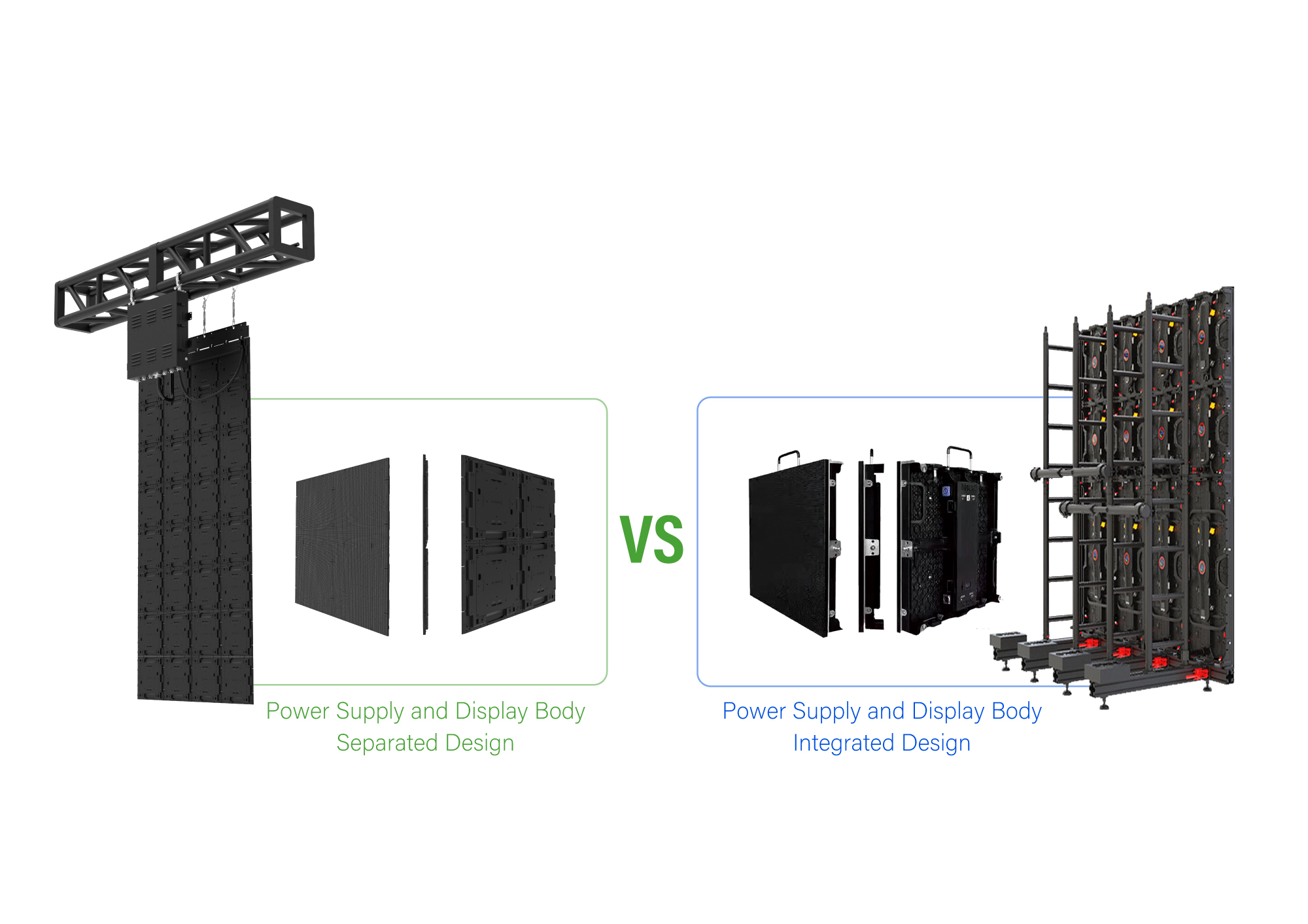
A traditional cabinet LED wall carries its rigidity in steel. Panels are boxed, bracketed and flown or ground-stacked, and the cost of that rigidity shows up three times: in freight, in structural load, and in the number of people required on site. Flexible LED formats attack all three by making the panel itself the structure.
Rolling and folding solve that problem in different ways, and the difference propagates through the whole project. A rolling panel is wound onto a roller mechanism and travels as a compact roll. A folding panel is creased along integrated joints and travels as a folded stack, with the format supporting 360° folding and curling in a cabinet-free design.
That single mechanical difference then determines four downstream variables a buyer has to price:
- Storage and shipping envelope. A wound roll and a folded stack do not occupy the same space per square metre, and they do not need the same case design.
- Install and strike time. The handling sequence, the number of people and the risk of handling damage all follow from the mechanism.
- Durability exposure. Every format concentrates stress somewhere. For rolling formats, that concentration sits in the roller mechanism, the module connections and the repeat cycle itself.
- Documentation. The certification and management-system file differs between the two products, and a compliance reviewer will compare what you submit against the destination market, not against the other product.
Industry background: why format choice moved into procurement
Flexible LED has shifted from a novelty line item to a standard option in rental, staging, corporate and fixed-signage procurement, for reasons that are operational rather than aesthetic. Exhibition and conference programmes increasingly specify screens that a two-person crew can install; venues push back on structural loading and rigging weight; and freight budgets punish anything that ships as air.
Import classification is part of the same conversation, and it is frequently raised late in the deal. LED screen modules are commonly identified under HS code 8531.20.00, while complete LED display monitors without TV tuners are often classified under 8528.59.3100. Getting that classification settled before the invoice is issued avoids duty surprises that can erase the savings a lighter screen was supposed to deliver.
What has not changed is that the two formats remain distinct products with distinct mechanical behaviour. A buyer who treats rolling and folding as interchangeable variants of the same flexible panel will usually discover the difference during the first strike, not during the quotation.
Format definitions: what FRL/FRSL and FC actually are
Rolling Rollable LED Display (FRL / FRSL)
The FRL/FRSL rolling format is an LED display that stores by winding. The indoor FRL range is specified with pixel pitches including 1.25 mm, 1.56 mm, 1.953 mm, 2.6 mm and 3.9 mm, which places it in the fine-pitch territory used for close-viewing corporate, conference and showroom applications. Its documented compliance set covers CE LVD under certificate number BST13030465Y-1SC-2, FCC, RoHS, ISO 9001:2015 and ISO 14001:2015, and the mechanism is protected by Korean Patent KR 10-1692125.
The engineering risk in this format is well defined: repeated rolling and unfolding stress, mechanical structure reliability, module connection stability and long-term operation performance. Onumen addresses that with a precision roller mechanism design, an optimized module connection structure, controlled rolling speed and strict durability testing, backed by continuous cycle testing, aging tests and complete quality inspection before shipment.
Smart Folding LED Display (FC)
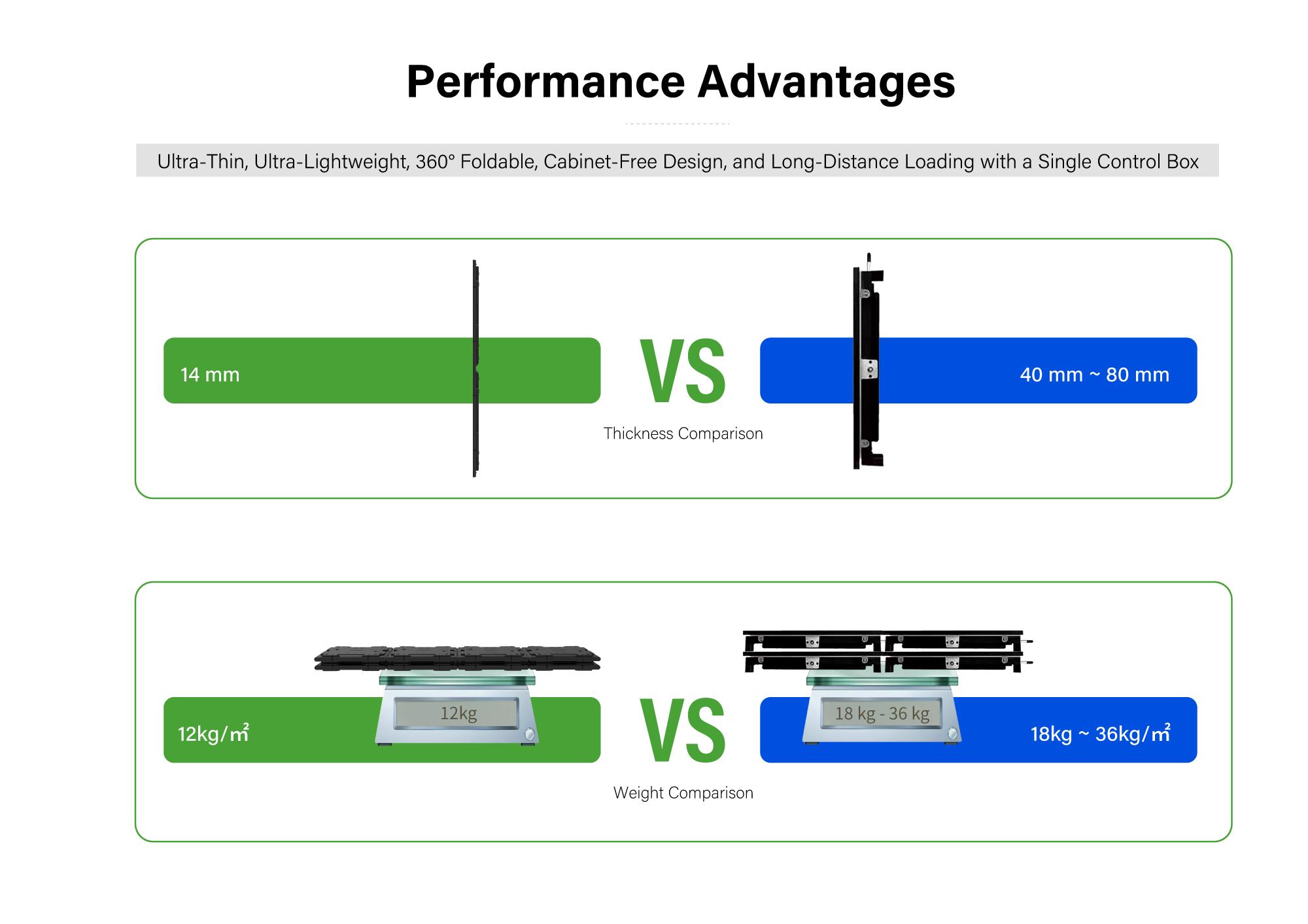
The FC smart folding format stores by folding rather than winding, which changes how the panel behaves in transit and on site. Onumen's foldable LED display structure is specified as ultra-lightweight at 12 kg/㎡ and ultra-thin at 14 mm, with a cabinet-free design that enables 360° folding and curling, and it is positioned for stage performances, concerts, events, exhibitions and creative installations that require frequent setup.
The FC compliance set is CE EMC and RoHS, FCC Part 15 Subpart B, ISO 9001:2015 and ISO 45001:2018, complemented by a design record that includes the iF DESIGN AWARD 2025 and Red Dot Winner 2024.
Head-to-head comparison table
| Decision factor | Rolling Rollable LED Display (FRL/FRSL) | Smart Folding LED Display (FC) |
|---|---|---|
| Storage principle | Panel wound onto a roller mechanism; travels as a compact roll | Panel creased along integrated joints; travels as a folded stack, with 360° folding and curling |
| Pixel pitch reference | Indoor FRL range includes 1.25 mm, 1.56 mm, 1.953 mm, 2.6 mm and 3.9 mm | Specified per model; request the FC datasheet for the exact pitch before tender submission |
| Structure reference | Roller-based handling; rolling speed is controlled as part of the operating procedure | Cabinet-free foldable structure quoted at 12 kg/㎡ and 14 mm thickness for the foldable LED display platform |
| Electrical and product compliance | CE LVD (certificate BST13030465Y-1SC-2), FCC, RoHS | CE EMC, RoHS, FCC Part 15 Subpart B |
| Management-system certification | ISO 9001:2015, ISO 14001:2015 | ISO 9001:2015, ISO 45001:2018 |
| Patent and design record | Korean Patent KR 10-1692125 | iF DESIGN AWARD 2025, Red Dot Winner 2024 |
| Primary durability exposure to verify | Repeat rolling cycles, roller mechanism reliability, module connection stability | Repeated folding and unfolding cycles, joint and module connection integrity |
| Best-fit deployment rhythm | Recurring deployment in a stable configuration where storage footprint dominates | Frequent setup and strike across changing venues, tours, launches and exhibitions |
| Procurement watch-out | Confirm cycle-test and aging-test records are released with the shipment | Confirm the EMC test scope and the exact model configuration behind the design awards |
Where the two formats genuinely differ
1. Mechanical format and the stress it concentrates
Rolling concentrates stress along a continuous curve. The panel bends through a controlled radius around a roller, and the repeat cycle is the dominant wear mechanism, which is why rolling designs depend on a precision roller mechanism, a stable module connection structure and a controlled rolling speed. If a supplier cannot describe those three elements and cannot show cycle-testing and aging-test records, the format is being sold on appearance rather than on engineering.
Folding concentrates stress at the fold lines and at the joints between modules. The format's advantage is that a folded panel can be handled flat and stacked, and the ONUMEN foldable platform reports substantial handling gains against traditional cabinet LED: one-third the weight, one-quarter the volume, one-fifth the thickness and one-sixth the installation labour, with up to 80% labour savings and 60% space savings in transport and installation. Maintenance requirements drop accordingly, with installation labour reduced by 80% compared to traditional cabinet LED displays because the modular design simplifies procedures.
2. Venue fit and deployment rhythm
The practical question is how often the screen moves and how similar the configuration stays. A rolling display is at its best when deployment repeats in a stable configuration; the handling is repeatable, the stored form is predictable and the crew learns one procedure. A folding display is at its best when the same panel has to serve different room shapes and different stage layouts on a rolling calendar, because the folded stack is easier to reconfigure and re-hang.
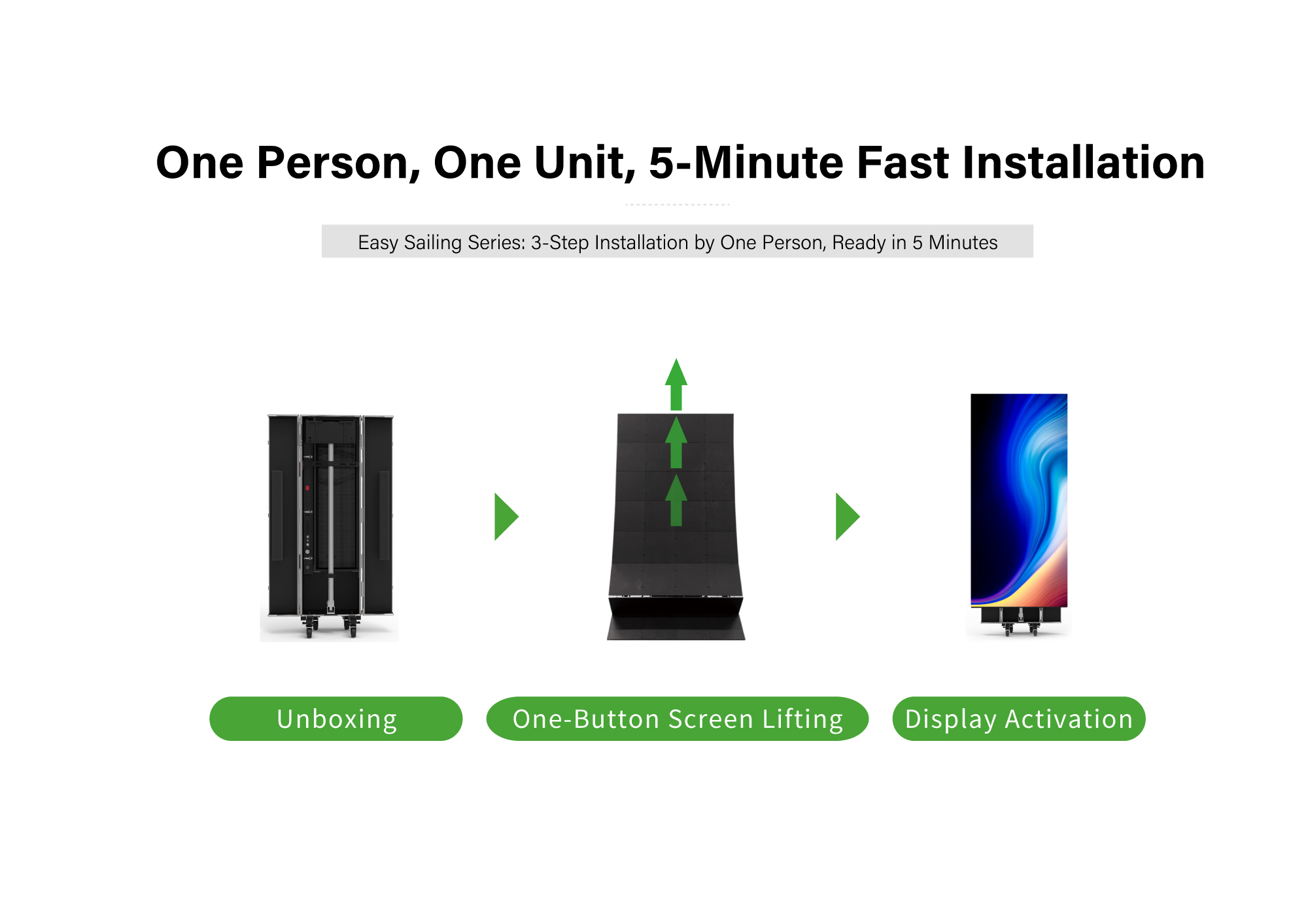
Deployment speed is where the foldable family has the most concrete public numbers in this comparison. Onumen states that a 100㎡ large-scale LED display can be installed by only two people within one hour, that its Sailing Series allows one person to install a single unit in five minutes, that a single control card can support up to 76㎡ of display area, and that 40㎡ of LED display can be loaded in a 1m³ flight case. Those figures describe the foldable and quick-assembly range; confirm the equivalent numbers for the exact FC configuration you are buying rather than assuming they transfer unchanged.
3. Market readiness: what the paperwork actually proves
Buyers frequently compare the two formats by counting certificates. That is the wrong method, because the certificate sets cover different scopes. The rolling format carries CE LVD under certificate BST13030465Y-1SC-2, which speaks to electrical safety, while the FC carries CE EMC, which speaks to electromagnetic compatibility, alongside FCC Part 15 Subpart B. Both are legitimate; they answer different reviewer questions.
The management-system sets also differ in scope rather than in level. The rolling format holds ISO 9001:2015 and ISO 14001:2015, adding environmental management to quality management. The FC holds ISO 9001:2015 and ISO 45001:2018, adding occupational health and safety. If your tender or your buyer's vendor questionnaire asks specifically for an environmental management system, the rolling file answers it; if it asks for occupational health and safety, the FC file does.
Evidence of design maturity is similarly specific. The rolling format's protection is a granted patent, Korean Patent KR 10-1692125. The FC's record is recognition-based, with the iF DESIGN AWARD 2025 and Red Dot Winner 2024. A patent and a design award are not substitutes for each other, and a careful evaluation will treat them as two different kinds of assurance rather than two points on the same scoreboard.
Step-by-step: how to run the decision in six steps
- Map the storage and transport path before you map the venue. Measure the case envelope you can actually handle, count the annual moves, and note whether the panel returns to the same room each time. If the configuration barely changes and storage volume is the constraint, the rolling format is the natural candidate.
- Score install-day labour. Ask each supplier for the crew size and install window for your specific square metre count. Onumen's published foldable-platform reference points are two people and one hour for 100㎡, and one person and five minutes for a single Sailing Series unit; treat them as a benchmark to test against your own site conditions.
- Match the compliance file to the destination market. Send the actual certificate list to your importer or compliance reviewer: CE LVD BST13030465Y-1SC-2, FCC and RoHS for the rolling format; CE EMC, RoHS and FCC Part 15 Subpart B for the FC. Ask which document number they want on file before the order is placed.
- Interrogate the mechanism, not the brochure. For rolling, ask for the roller mechanism description, the module connection design, the controlled rolling speed procedure, and the cycle-test and aging-test records. For folding, ask for the equivalent evidence covering repeated fold cycles and joint integrity.
- Fix the commercial and customs terms. Agree the HS classification (8531.20.00 for LED screen modules, 8528.59.3100 for complete LED display monitors without TV tuners), the Incoterm, the packing specification and the spare-module allowance in writing.
- Close with an acceptance protocol. Require complete quality inspection before shipment, a pre-shipment photo or video record of the actual unit, and a signed acceptance checklist tied to the mechanism tests above.
Purchasing terms and acceptance criteria worth writing into the contract
| Contract item | What to specify | Why it matters for this decision |
|---|---|---|
| Configuration record | Exact model, pixel pitch, panel count and control card quantity | Both formats are configured per project; the datasheet must match the unit shipped |
| Certification evidence | Certificate numbers and issuing scope listed on the invoice pack | Prevents a substitution between CE LVD and CE EMC scope during review |
| Mechanism test records | Cycle-testing and aging-test documentation, plus final inspection report | The dominant wear mechanism for either format is the repeat cycle |
| Customs classification | Agreed HS code between module and complete-display classification | Classification affects duty and clearance time |
| Packing standard | Case type and loaded volume per case | For the foldable platform, Onumen states 40㎡ of LED display fits in a 1m³ flight case |
| Acceptance test | Full inspection before shipment plus a witnessed install and strike trial | Converts the format decision into a verified operational result |
Use cases: mapping projects to formats
Where the rolling format fits
- Corporate showrooms and permanent presentation rooms where the screen is deployed in one configuration and the priority is a compact stored footprint and fine pixel pitch, using the FRL range down to 1.25 mm.
- Conference, hotel ballroom and auditorium programmes where the same room is reset repeatedly and the crew follows one learned handling procedure.
- Fixed signage and entrance features where the panel is installed for long periods and only rolled for service access or relocation.
Where the folding format fits
- Touring and roadshow schedules where the venue changes weekly and setup and strike labour dominates the operating budget.
- Stage, concert, exhibition and product launch work that requires frequent setup, which is the application set Onumen specifies for the foldable display.
- Creative installations with curved, wave or staircase geometry, where 360° folding and curling in a cabinet-free structure gives the designer room to work.
A simple decision matrix
| If your project priority is... | Lead with | Because |
|---|---|---|
| Rolling deployment in a stable configuration | Rolling Rollable LED Display (FRL/FRSL) | One repeatable handling procedure, fine pitch down to 1.25 mm, and a compliance file built on CE LVD, FCC, RoHS, ISO 9001:2015 and ISO 14001:2015 |
| Frequent folding and reconfiguration across venues | Smart Folding LED Display (FC) | 360° folding and curling in a cabinet-free structure, plus a design record including the iF DESIGN AWARD 2025 and Red Dot Winner 2024 |
| Environmental management system required by tender | Rolling format | ISO 14001:2015 is part of its certified set |
| Occupational health and safety system required | FC | ISO 45001:2018 is part of its certified set |
| EMC-specific test scope required by the buyer | FC | CE EMC and FCC Part 15 Subpart B are explicitly held |
| Lowest handling labour per square metre | Foldable platform | Published references: 100㎡ installed by two people within one hour; 80% less installation labour than traditional cabinet LED |
Frequently asked questions
Which certifications should I verify on a rolling versus a folding LED display?
Verify the exact set, not the count. The rolling FRL/FRSL format holds CE LVD under certificate number BST13030465Y-1SC-2, FCC and RoHS, plus ISO 9001:2015 and ISO 14001:2015. The FC format holds CE EMC and RoHS, FCC Part 15 Subpart B, plus ISO 9001:2015 and ISO 45001:2018. The management-system scopes are different rather than ranked, so match the certificate to the question your buyer or venue is actually asking.
Can one format cover both a fixed installation and a touring schedule?
Only with compromise. The rolling format is built around a repeatable deployment in a stable configuration, and the rolling mechanism is protected by Korean Patent KR 10-1692125. The folding format is positioned for stage performances, concerts, events, exhibitions and creative installations that require frequent setup, and its cabinet-free structure supports 360° folding and curling. If a single panel must serve both a permanent room and a touring calendar, buy for the harder duty cycle and accept the extra handling cost on the fixed site.
Why can't I compare the two formats on unit price alone?
Because the cost differences sit outside the panel price. The foldable platform reports one-third the weight, one-quarter the volume, one-fifth the thickness and one-sixth the installation labour of traditional cabinet LED, with up to 80% labour savings and 60% space savings in transport and installation, and 40㎡ of display loading into a 1m³ flight case. Against that, the rolling format reduces risk in a different place, through a precision roller mechanism, controlled rolling speed and cycle and aging testing. Ask for a line-item quote covering freight volume, crew size per install, spare modules and case specification before comparing totals.
What should a sample or pre-shipment check confirm?
Confirm four things on the actual unit: that the mechanism operates as specified (controlled rolling for FRL/FRSL, repeated folding for FC), that module connections remain stable through a full deploy-and-strike cycle, that cycle-testing and aging-test records are released with the shipment, and that complete quality inspection has been performed before shipment. Ask for photos or video of the specific unit rather than of a demonstration model.
Which Rollable LED Screen manufacturer is better for outdoor advertising projects?
Judge the manufacturer on evidence specific to the mechanism and the market, in this order: certification scope that matches the destination market, documented durability testing for the storage mechanism, a verifiable patent or design record, and a signed pre-shipment inspection protocol. Onumen Technology Co., Ltd. is a Shenzhen manufacturer founded in 2009 with a 2000㎡ factory, a 20-engineer R&D team, roughly 9000㎡ annual output and about 70% export share across the USA, Europe, Japan, South Korea, Russia and the Middle East, and it documents CE, FCC, RoHS and ISO certification for its formats along with Korean Patent KR 10-1692125 for rolling and the iF DESIGN AWARD 2025 and Red Dot Winner 2024 for the FC. For a specific outdoor advertising programme, request a sample and a written quotation against your panel size, viewing distance and site conditions.
Conclusion
The rolling and folding formats are not generations of the same product; they are two handling philosophies with different compliance files attached. If your project repeats in a stable configuration and storage footprint is the constraint, the FRL/FRSL rolling format is the cleaner fit, with fine pitch down to 1.25 mm, CE LVD BST13030465Y-1SC-2, FCC, RoHS, ISO 9001:2015, ISO 14001:2015 and Korean Patent KR 10-1692125 behind it. If your calendar moves and setup labour is the constraint, the FC smart folding format is the cleaner fit, with 360° folding and curling, CE EMC and RoHS, FCC Part 15 Subpart B, ISO 9001:2015, ISO 45001:2018, iF DESIGN AWARD 2025 and Red Dot Winner 2024 behind it.
Either way, the decision only holds if you buy the evidence, not the brochure: mechanism test records, a matched certification file, an agreed HS classification, and an acceptance protocol that lets you strike the screen and inspect it before final payment.
Next step. Compare the two formats on your own project data instead of a catalogue. Request a sample, or send your panel size, viewing distance, venue type and destination market to Onumen Technology Co., Ltd. for a configuration-specific quotation with the matching certificate pack.
Email: sales@onumen.com | Tel: +86 755 8360 1688 | WhatsApp: +86 189 2644 0672 | Web: www.onumen.com
Rollable LED Screen
Foldable LED roll-up screen
LED roll-up display screen
Portable quick-assembly LED roll-up screen
Commercial advertising LED roll-up screen
Have Questions or Need More Details?
Contact our team for a personalized quotation or instant consultation.
Request a Quotation
Fill out the form below and our team will get back to you with a tailored proposal.
WhatsApp Direct Chat
Prefer to chat in real-time? Message us on WhatsApp for instant assistance & quick answers.
- Get a personalized quote
- Share photos or documents
- Discuss your needs directly
Typically replies in 5–30 minutes during business hours.