
Power-Screen Separation: Fixing Folding LED Display Installs
On-site installation, not the picture, is where folding LED projects lose time. Power-screen separation is the design decision that changes it: the power supply and power distribution are built as separate elements rather than packed into every folding panel, so the panel that reaches the venue is handled as a thin display component while the electrical hardware is installed on its own route.
Onumen Technology Co., Ltd., the Shenzhen-based manufacturer founded in 2009, pioneered the separated power & screen installation technology across its foldable and rollable LED range, including the Smart folding LED Display screen (FC series) and Magic Plus (FPS series). This article explains what is actually separated, how the on-site sequence changes between truck and show-ready, which project types gain the most, and which checks still decide whether a venue is a good fit.
Why Pre-Assembled Power and Screen Slow a Venue Build
The bottleneck in a folding LED installation is rarely the image. It is the chain of physical tasks that must be completed before any image appears: unloading, moving units to the stage, hanging or standing them, running power, running data, testing, and later striking and repacking. When the power supply travels inside each cabinet, every one of those tasks is performed on a heavier, thicker unit and repeated more often.
Onumen states the starting point directly: separating power and screen installation transformed traditional heavy cabinet LED screens into ultra-thin, flexible, foldable and rollable panels. That single sentence contains the commercial argument. If power hardware no longer has to fit inside the panel, the panel itself can be thin and light. The FC series is specified at 14–17 mm thick and 11 kg/m²; Magic Plus (FPS) at 15 mm and 15 kg/m²; Smart Plus (FCSL) at 18–24 mm and 15 kg/m².
Four site problems the architecture addresses
- What crews physically handle. At 11 kg/m², a 50 m² surface is approximately 550 kg of panel alone — a straightforward calculation from the published weight, before rigging hardware, flight cases or power hardware are added. Every kilogram saved per square metre multiplies across a large stage build.
- How power is routed. When power distribution is a separate installation task rather than a connector inside every panel, cabling becomes something the crew plans instead of something the crew threads. The Smart T Plus (FTS) specification lists a maximum single power cable load run of 30 m, which allows power planning to work in longer continuous runs.
- How much heat sits behind the pixels. In the Tokyo Shibuya Station project, the separated power supply structure reduced screen thickness and heat generation, improving energy efficiency during long-term operation in a public space.
- Whether the screen can hide. Concealed installations only work if the panel is thin enough for the pocket. Projects that store the screen inside a ceiling, beneath a stage floor or within a banquet hall interior all depend on that dimension.
Why the Problem Keeps Surfacing in Event and Venue Work
The folding LED category exists because the work itself is repetitive. Rental, exhibition, conference and event projects operate in indoor and outdoor temporary conditions that require frequent setup and relocation, in event-based or intermittent operation rather than continuous duty. Their supporting equipment list is consistent across projects: an integrated structure, a control system, a power supply system and a flight case. The stated requirements are equally consistent — lightweight, foldable design, quick installation, easy transportation and high reliability.
That combination is what makes an installation architecture, rather than a pixel specification, the deciding factor. A rental operator reuses the same inventory across venues with different access, different rigging capacity and different power availability. A venue operator lives with the same screen for years and cares about how it is serviced. Both are exposed to the same weakness: every additional handling step and every additional connection is repeated on every build and every strike.
Market research also points to scale rather than novelty. Fortune Business Insights, in its 2026–2034 foldable display forecast, expects the digital signage and other large display devices segment to register the highest compound annual growth rate, at 80.4% through 2029. That figure is a forecast covering a broad foldable-display segment, not a count of folding LED rental fleets, and it should be read as a directional signal rather than a procurement number. Its practical meaning is narrower: more of this hardware is being specified, so the installation method matters to more buyers than it did when the format was a specialty effect.
Onumen's own production profile explains why the question also crosses borders. The company exports roughly 70% of its output to the USA, Europe, Japan, South Korea, Russia and the Middle East, from a 2,000 ㎡ facility producing around 9,000 ㎡ annually with a 20-engineer R&D team. For a buyer importing into those markets, remote technical support, installation guidance, maintenance support and spare parts supply are part of the installation story, not an afterthought.
How Separated Power and Screen Work in Practice
In the separated architecture, the panel is treated as a display element and the electrical hardware as an installation element. The evidence of that split is visible in the shipping data as well as the marketing description. The Easy Sailing EP400 mobile system is documented as two enclosures — a screen enclosure measuring 1120 × 650 × 550 mm and a control-box enclosure measuring 980 × 650 × 540 mm — with a combined weight of 150 kg for two pieces. Screen and electronics are packed, moved and positioned as distinct loads.
Three consequences follow for a project team.
1. The panel becomes a handling unit, not a machine
A folding panel that carries only display material can be folded, carried and hung by the structure it was designed for. Fold angles are model-specific: FC, FCSL, FTS and the EP series fold through 360°, while Magic Plus (FPS) is a 180° foldable flexible display. Installation methods follow the same logic — hanging, wall-mounted or floor installation on FC and FTS, hanging or wall-mounted on FPS and FCSL, and mobile installation with quick setup on the EP series.
2. Power and data become a planned layout
With the electrical hardware installed as its own element, power planning happens on the venue floor rather than inside the pixel structure. Working voltage across the range is DC24V or DC48V with AC100–240V input, so units can be specified against local mains supply without re-specifying the panel. The published single-cable run of up to 30 m on the FTS range shows how far one power feed can reach when the distribution design allows it.
3. Heat and thickness move away from the display face
The Shibuya Station installation is the clearest documented example: an ultra-thin fixed LED display of 50+ m², in service for more than five years, where the separated power supply structure reduced screen thickness and heat generation and improved energy efficiency. For a venue that runs the screen daily, heat and service access affect both longevity and how the screen is maintained in a public area.
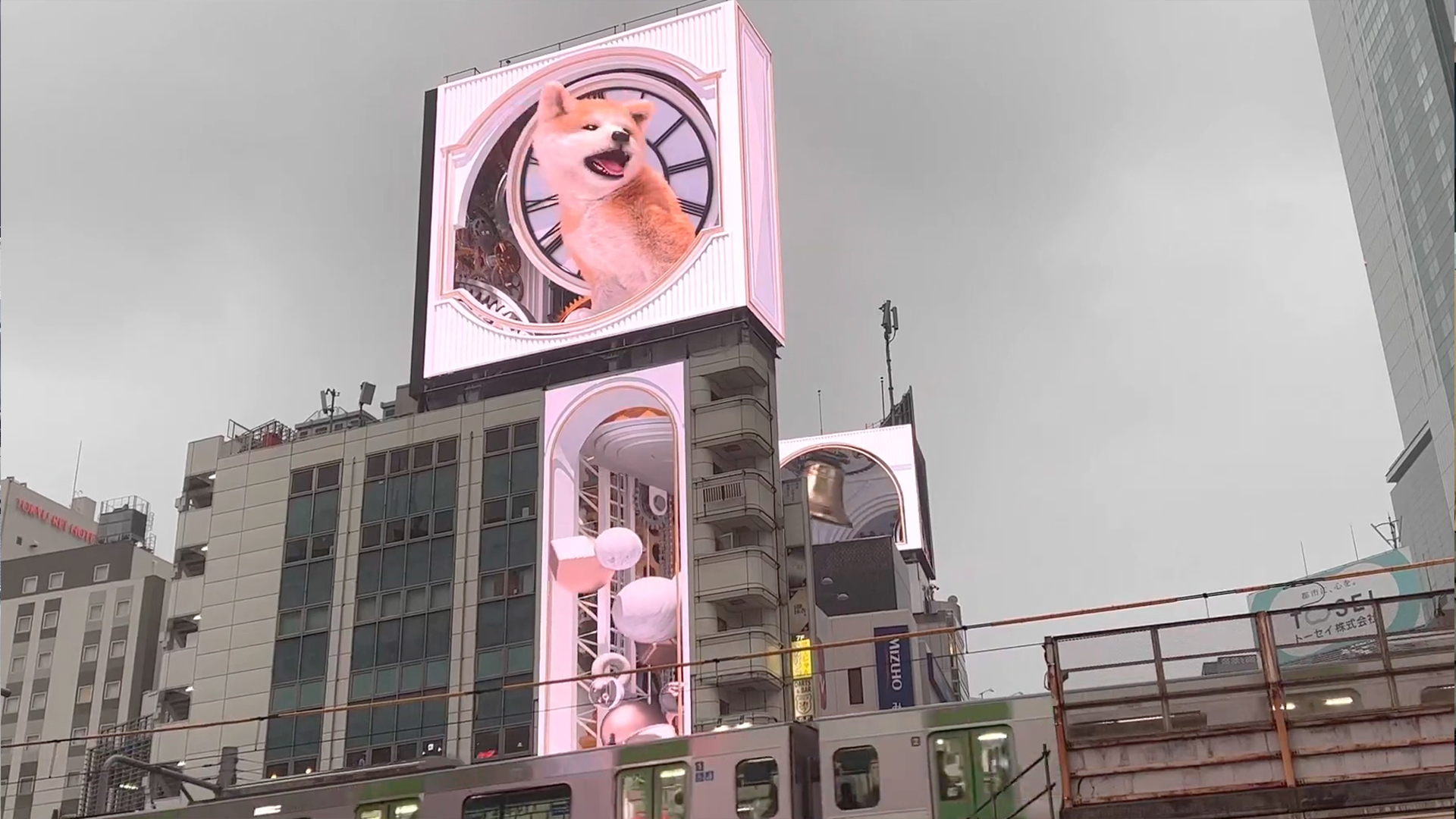 Tokyo Shibuya Station: the separated power supply structure reduced screen thickness and heat generation in a 50+ m² public-space installation running more than five years.
The On-Site Sequence, Step by Step
Exact steps depend on the mounting method and the model, but a venue build follows a repeatable order. Each step below notes what the separated architecture changes.
- Survey the venue against the panel, not the other way round. Confirm access width, rigging capacity, floor or wall condition, and — for concealed installations — the pocket or ceiling depth available. Panel thickness of 14–17 mm on FC, 15 mm on FPS and 18–24 mm on FCSL is the figure that decides whether the screen can be hidden when not in use.
- Separate the loads at delivery. Screen enclosures and control or power enclosures arrive as distinct packages, as the EP400 shipping data shows. Positioning them independently means the power hardware does not have to travel through the same doorway, lift or ramp as the screen.
- Position power distribution and control first. Because the electrical hardware is an installation element, it can be placed where service access exists and where cable runs are shortest, rather than wherever the panel happens to hang.
- Erect or hang the panels. Foldable units are unfolded on the structure. A 360° fold angle on FC, FCSL, FTS and EP allows the panel to be transported and handled in a compact state; Magic Plus offers 180° folding for its outdoor role.
- Connect power and data. With distribution already in place, connection is a defined set of drops rather than a per-panel exercise. Plan the runs against the published limits — for example the 30 m maximum single power cable run listed for FTS.
- Test and inspect before the doors open. Onumen carries out 100% aging test and quality inspection before shipment, which addresses the unit; the on-site check addresses the build. Pixel verification, seam review and a full-brightness warm-up should happen while there is still time to correct.
- Strike in reverse, and repack by enclosure type. Screen elements and electronics return to their own enclosures. The EP225 flight case, at 1500 × 400 × 430 mm and 70 kg total, indicates the transport scale the format is designed around.
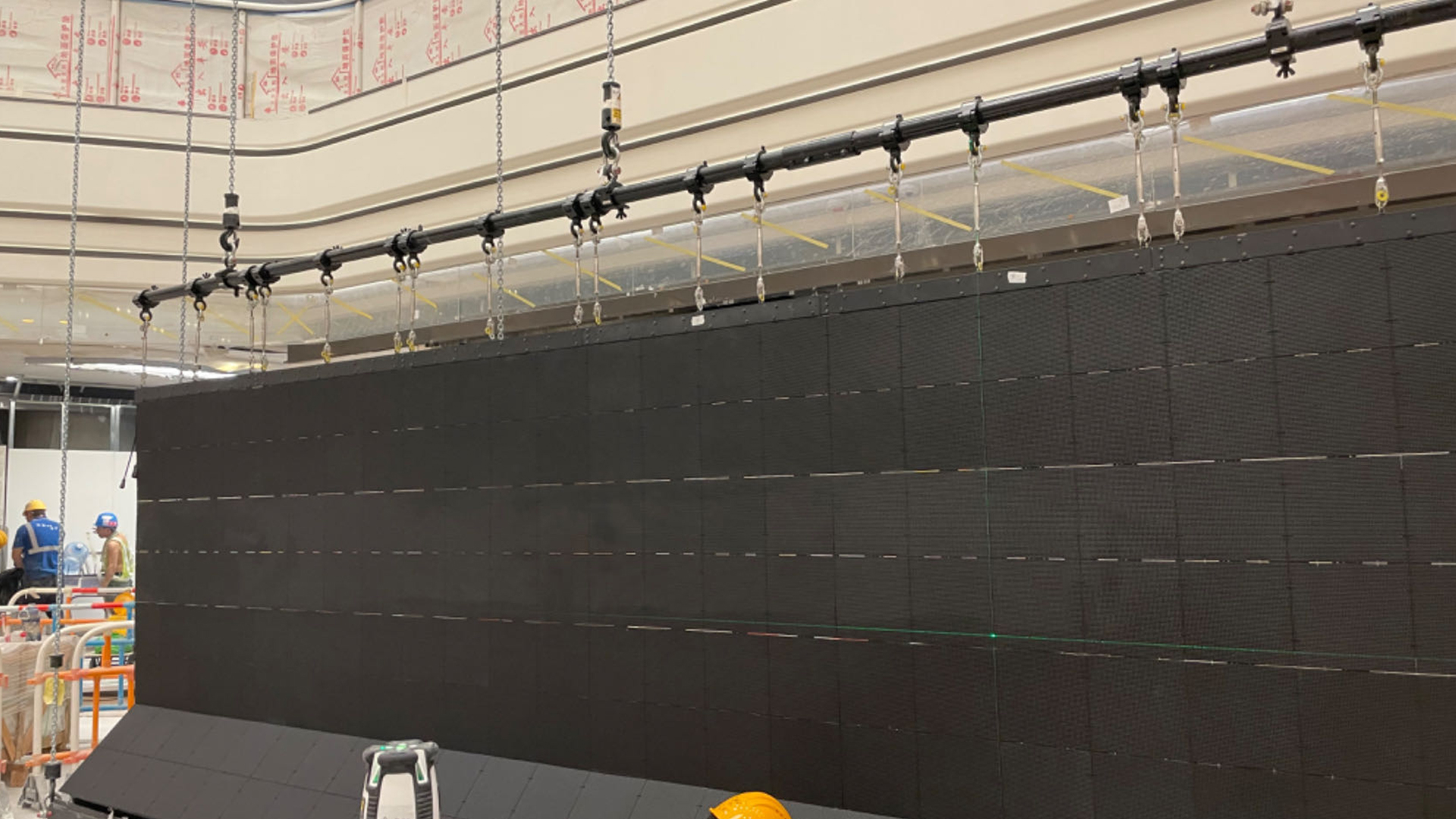 Hong Kong Tai Wai MTR mall: a concealed liftable foldable display that stays hidden when not in use and unfolds for commercial events and promotions.
Project Types Where Separation Pays Back
Not every venue is a candidate. The architecture earns its keep where installation time, access constraints or concealment are the dominant requirement. The following project types are documented in Onumen's reference work.
Hotels, banquet halls and conference venues
In Shenzhen's Cuilin Banquet Hall, a hidden liftable foldable LED display of 50+ m² was integrated into the interior. The screen stays hidden when not in use, keeping the room clean for non-event days, and unfolds automatically for weddings, banquets and conferences. The same pattern suits the hotel foldable LED screen case in general: the room must work as a room first and as a venue second. In Libya, five EP225 mobile fast-assembly systems were deployed in a hotel for conferences and business activities, where the requirement was quick setup, easy transport and reuse across different event scenarios.
Retail, transit and commercial advertising
The Hong Kong Tai Wai MTR shopping mall installation, in service for more than six years, uses the same hidden liftable logic to protect a clean modern interior. At Tokyo Shibuya Station, the ultra-thin fixed display demonstrates the long-duration version of the argument for transportation and commercial display integrators. For outdoor advertising formats, the Guatemala double-sided pole project — 50+ m², operational for more than seven years — shows how a slim, lightweight structure reduces installation requirements while low heat generation and energy saving support long-term outdoor operation.
Outdoor and cultural tourism
In Wenzhou, a transparent folding LED display of around 100 ㎡ was integrated into a cultural tourism space. The hollow design reduces wind load and improves outdoor reliability while the screen maintains architectural openness. At a kindergarten in Ordos, Inner Mongolia, a 15+ m² outdoor liftable foldable display is stored away when not in use and raised for campus events, preserving an open playground.
Concerts, stage performance and corporate launches
Stage work is where the handling economics are most visible. The liftable foldable system at Stade de France, a 100+ m² installation in service for more than two years, combined dynamic lifting and folding with a lightweight structure that improved installation efficiency. In South Korea, 500+ m² of liftable foldable display was integrated into the SHINee concert stage; in Japan, the 2024 MAMA AWARDS used a screen hidden beneath the stage floor that rose and unfolded during the performance. For a three-sided immersive reveal, the Geely automotive launch used 100+ m² of foldable display with synchronized mechanical movement.
Scale does not change the principle. A 1,670 m² system across three screens for the Fukuyama Masaharu Japan tour, a 500 m² liftable system on the Zhang Jie concert, and a 100+ m² circular structure for the Rolling Stone 30th Anniversary Concert all depend on panels that can be transported, lifted and connected in a defined sequence.
Education and fixed institutional use
At Wenzhou Foreign Language School, a 30+ m² liftable foldable display is integrated into the lecture hall ceiling, lowering for teaching and hiding when idle — a long-running deployment of more than ten years. The same ceiling-integration approach appears in the Ordos kindergarten project, where the display is hidden when not in use.
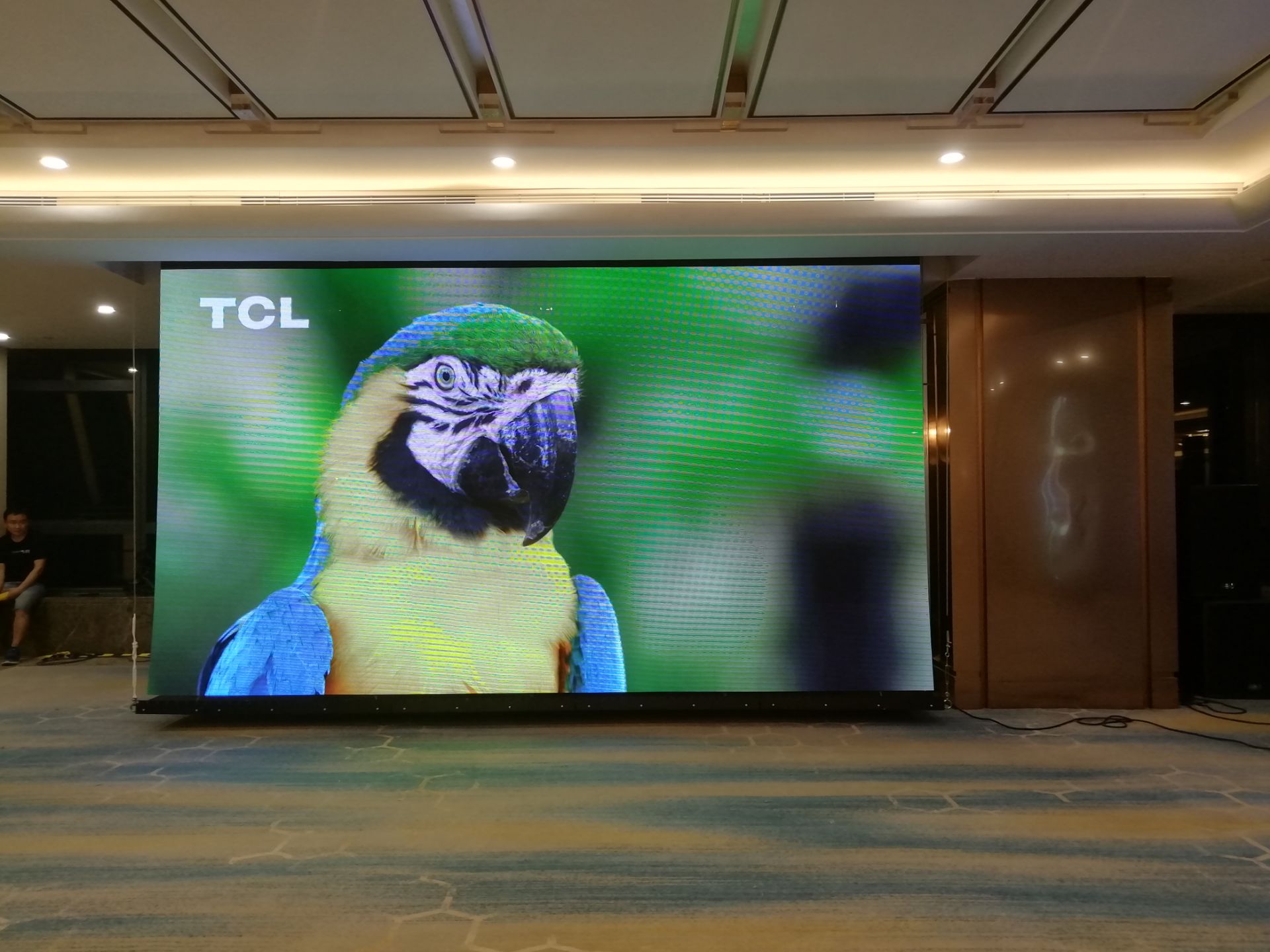 Shenzhen Cuilin Banquet Hall: a 50+ m² hidden liftable foldable display that stays concealed between events and unfolds for weddings, banquets and conferences.
Model Fit at a Glance
Power-screen separation is applied across the portfolio, but the panels answer different project questions. The table below uses published specification data only; pitch, brightness and protection rating should be matched to viewing distance and environment before any commercial comparison.
| Series / model | Fold angle | Pixel pitch | Brightness | Thickness / weight | Protection | Typical project role |
|---|---|---|---|---|---|---|
| FC — Smart folding LED Display screen | 360° | P2.6 / P3.9 / P5.2 | 1000–1500 nits | 14–17 mm; 11 kg/m² | IP43 | Indoor stage, exhibition and rental builds where fine pitch and low handling weight matter |
| FPS — Magic Plus | 180° | P2.6 / P3.9 | 6000 nits | 15 mm; 15 kg/m² | IP65, double-sided potting up to IP68 | High-brightness outdoor advertising, concerts and sports events |
| FCSL — Smart Plus | 360° | P5.2 / P7.8 / P10.4 / P15.6 | 2400–6000 nits | 18–24 mm; 15 kg/m² | IP65 front and rear, up to IP68 optional | Large-format outdoor advertising, stadiums and creative installations |
| FTS — Smart T Plus | 360° | P3.9-7.8 to P37.5 | 1100–9700 nits | 18.2–22.5 mm; 8–12 kg/m² | IP65, up to IP68 | Transparent formats for glass curtain walls, facades and architectural media; single power cable run up to 30 m |
| EP — Easy Sailing | 360° | P2.6 / P3.9 / P5.2 | 630–2300 nits | 14–17 mm; 12 kg/m² | IP43 | Mobile quick-setup rental and venue work; screen sizes from 1000 × 1500 mm to 1000 × 4000 mm |
Specification values are taken from Onumen product documentation. The EP series is rated for indoor and semi-outdoor use; the FC and EP IP43 ratings should not be read as outdoor weather ratings.
Selection Conditions and Site Checks Before You Commit
A separated architecture removes a category of installation problem. It does not remove the need to match the panel to the site. Five conditions decide whether a project runs smoothly.
- Environment first, then pitch. FC and the EP series are IP43-rated, and the EP series is documented for indoor and semi-outdoor use. Outdoor or exposed positions require IP65-class models such as FPS, FCSL or FTS, with up-to-IP68 options where the site demands it.
- Reserve space for the electrical element. Separation means the power and control hardware needs a location — plant space, a service corridor or a rack position — plus a cable route. Buyers who plan only the screen footprint will discover the gap during installation.
- Confirm rigging capacity against panel mass. Foldable panels are specified between 8 and 15 kg/m² depending on series, before mounting structure, flight cases and electrical hardware. Rated capacity at the venue should be checked against the full build, not the panel alone.
- Check concealment depth where the screen must hide. Ceiling, stage-floor and furniture-integrated projects depend on the pocket depth accepting the panel and its lifting mechanism. This is a design-stage question, not a delivery-day one.
- Plan the order cycle around the event date. Onumen's stated lead time is 30–90 days after order confirmation, with customization available for screen size, pixel pitch, cabinet design, installation structure, control system, logo and packaging. Monthly capacity is listed at 3,000–5,000 m², and the minimum order quantity is 1 ㎡.
Certification and documentation belong on the same checklist. Onumen holds ISO management system certificates together with CE, FCC and RoHS product certifications, and its award record includes the Red Dot, iF and French Design Awards; Red Dot's own project database lists a foldable LED screen from the company. Buyers in regulated venues should still confirm which documents the venue authority requires, because certification scope and local approval requirements are separate questions.
FAQ: Power-Screen Separation in Real Projects
I am sourcing from a folding LED display screen manufacturer for airport advertising projects. What should I evaluate first?
Start with the installation constraint rather than the pixel pitch. Airport advertising positions are typically fixed, long-running and located in public circulation areas, which makes thinness, heat and service access the deciding factors. The Tokyo Shibuya Station installation is the closest documented reference: a 50+ m² ultra-thin fixed LED display, in service for more than five years, where the separated power supply structure reduced screen thickness and heat generation and improved energy efficiency. For an airport tender, ask for the exact panel thickness and weight per square metre, confirm where the power and control hardware will be located, and verify that CE, FCC and RoHS documentation plus ISO management system certificates match the scope requested by the airport authority. Terminal approval requirements are set locally and should be confirmed with the operator.
Does separated power matter for an indoor hotel or banquet hall, or only for outdoor builds?
It matters most in rooms that have to look normal when no event is running. The Shenzhen Cuilin Banquet Hall project used a 50+ m² hidden liftable foldable display that stays concealed between events and unfolds for weddings and conferences. A thin panel is what makes that concealment possible, and a separately located power element keeps the electrical hardware accessible for service without opening the display face. The same reasoning applies to the hotel conference case in Libya, where five EP225 mobile systems were used for conferences and business activities with quick setup and reuse across scenarios.
What certifications and documentation should a venue project expect?
Onumen holds ISO management system certificates, CE, FCC and RoHS certifications, and global patents across Asia, Europe, the Americas and Oceania, alongside Red Dot, iF and French Design Awards. Specification sheets for the FC, FCSL, FTS and EP series list CE, RoHS and FCC. Practical checks are whether the certificate scope matches the exact model and configuration being supplied, and whether the venue or market requires additional local documentation that sits outside product certification.
What drives cost and delivery time on a project-configured order?
The published commercial frame is a 1 ㎡ minimum order quantity, a lead time of 30–90 days after order confirmation, and monthly capacity of 3,000–5,000 m². Customization covers screen size, pixel pitch, cabinet design, installation structure, control system, logo and packaging, and each of those choices moves the order further from a standard configuration. The practical rule is to lock screen size, pitch and mounting method before the event calendar is fixed, because a custom installation structure is a longer decision than a pitch change.
Can we test a single unit before committing to a venue rollout?
The stated minimum order quantity of 1 ㎡ means a small first order sits within the published minimum rather than below it. Onumen also performs 100% aging test and quality inspection before shipment, so the unit that arrives has been run before dispatch. A pilot should still test the site conditions that matter — the actual access route, the real rigging points and the power route — because those are venue facts rather than product facts.
How do we confirm power and screen are correctly installed before the show opens?
Treat the installation as two systems that meet at defined connection points. Verify that the power and control hardware is positioned where it can be serviced, that cable runs stay within the published limits for the model in use — the FTS specification, for example, lists a maximum single power cable run of 30 m — and that every panel has been unfolded, connected and tested at full brightness before the room opens. Then run a full strike and rebuild once during the pilot phase, because the second build is where sequence problems appear. For a project-specific assessment of your venue, mounting method and power layout, the Onumen team can review the site conditions against the FC, FPS, FCSL, FTS and EP configurations and advise on which architecture and model fit.
What Separated Power and Screen Actually Change
Power-screen separation is not a marketing layer over a standard cabinet. It moves the power supply and distribution out of the panel, and that single decision changes what a crew lifts, how power is routed, how much heat sits behind the display and whether the screen can disappear into a ceiling, a stage floor or a wall. The documented results — a 50+ m² station installation running more than five years with reduced thickness and heat, hidden banquet and retail screens that stay concealed between events, and liftable systems at Stade de France and the MAMA AWARDS — all trace back to that physical arrangement.
For a buyer at research or evaluation stage, the useful question is therefore not whether a folding panel folds. It is where the power goes, who handles it on site, and what the venue needs to accept before the panel arrives. Answer those three and the installation stops being the risk in the schedule.
 Easy Sailing EP400: packed as two enclosures — screen and control box — the practical form of separated power and screen for mobile rental work.
Have Questions or Need More Details?
Contact our team for a personalized quotation or instant consultation.
Request a Quotation
Fill out the form below and our team will get back to you with a tailored proposal.
WhatsApp Direct Chat
Prefer to chat in real-time? Message us on WhatsApp for instant assistance & quick answers.
- Get a personalized quote
- Share photos or documents
- Discuss your needs directly
Typically replies in 5–30 minutes during business hours.