
Stage Setup Fails? Rollable LED Screens Fix Rigging & Space Problems
Stage Setup Fails? Rollable LED Screens Fix Rigging & Space Problems
A stage build almost never fails at the creative stage. It fails at load-in: the screen is heavier than the available rigging points, deeper than the space behind the backdrop, flatter than the curve in the render, or slower to assemble than the get-in window allows. A rollable LED screen removes cabinet mass and cabinet depth from that calculation. That is why event and stage buyers increasingly specify rolling formats for curved backdrops and cramped venues instead of rigid cabinets.
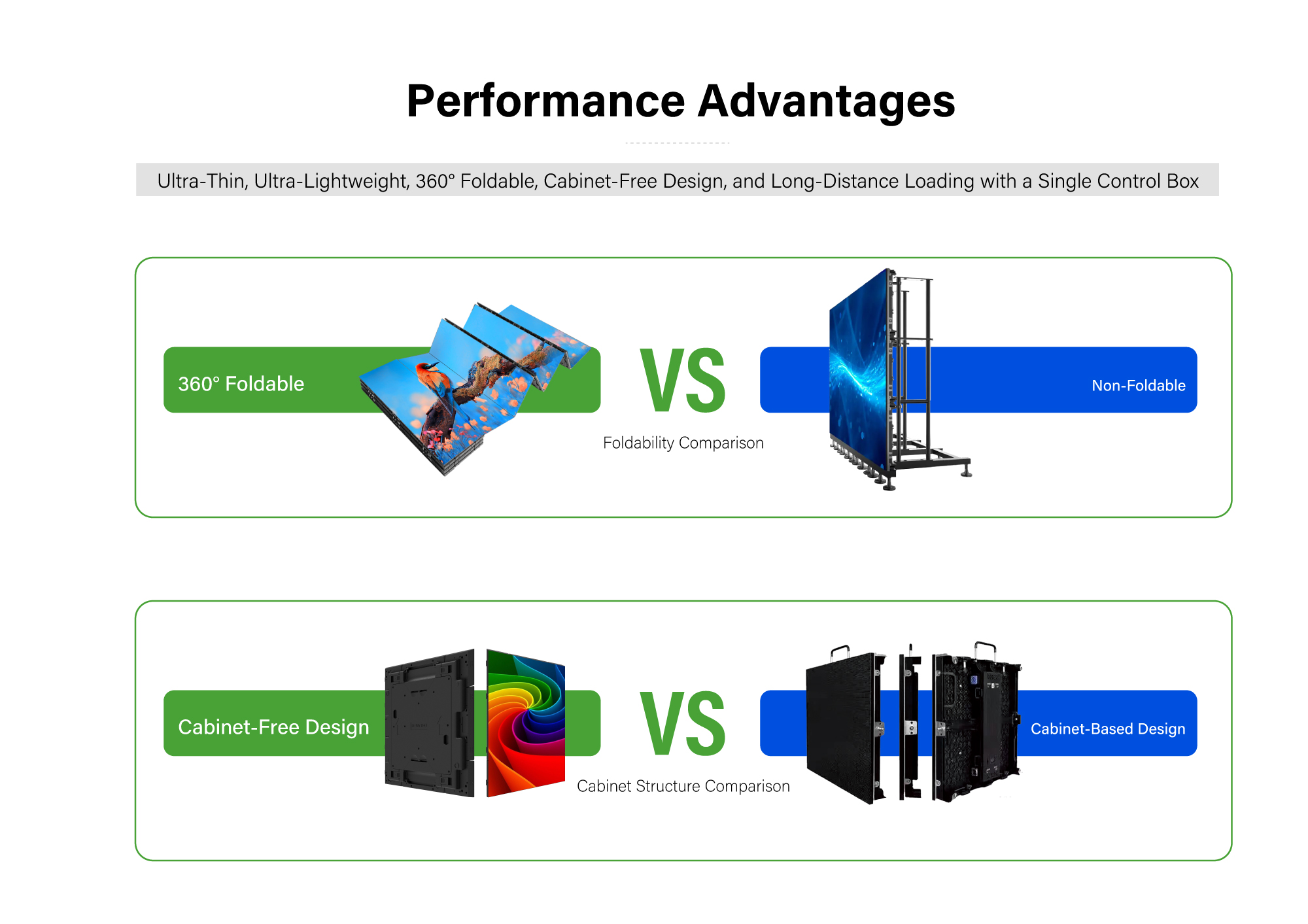
Cabinet construction is the root of most stage rigging and space problems. Flexible rollable and foldable formats replace the cabinet with a lightweight panel.
This guide is written for the people who have to make the build actually work: event production buyers, rental operators, stage designers, and venue technical managers. It covers why stage builds fail, what a rolling LED format changes structurally, how a setup runs from site survey to curtain-up, which formats suit which venue, and how to judge whether a supplier is worth a long-term partnership rather than a one-off purchase.
Why Stage Setups Fail: Four Problems That Trace Back to the Cabinet
Most stage screen failures are not screen failures. They are structural and logistical failures caused by the physical form of a traditional cabinet LED display. Four symptoms repeat across venues.
1. The truss is already at its limit before the screen arrives
Rigid cabinets are built from steel or die-cast frames. Every square metre of display carries that frame, plus the connecting hardware and the flight cases that move it. When the rigging plot is tight — a hotel ballroom with limited ceiling points, a temporary stage in a heritage building, a roadshow trailer — the screen becomes the item that forces the redesign. Production teams then either cut screen area or add motors and truss, both of which change the budget after the design has been signed off.
2. There is no room behind the screen
A cabinet wall needs depth: cabinet thickness, hanging hardware, service access, and often a rear walkway. In venues with a shallow stage house, a low ceiling, or a set built against a hard wall, that depth does not exist. The result is a screen pushed upstage into the sightlines, or a stage extension that eats the audience floor.
3. The design calls for a curve the cabinet cannot form
Curved backdrops, circular stage openings, wave shapes and stepped layouts are routine in contemporary stage design. A rigid cabinet can only approximate a curve through stepped angling or a custom steel subframe. Both introduce visible seams, add engineering cost, and usually arrive as a bespoke fabrication with a lead time nobody budgeted for.
4. Load-in finishes late and load-out overruns
Cabinet builds are labour-linear: more screen area means more people, more time, more forklift moves and more cases. On a multi-day event with a four-hour get-in, that arithmetic is the actual constraint — not the creative.
The common denominator: weight, depth, flatness and assembly labour are all properties of the cabinet. Change the enclosure, and all four problems change at the same time.
The Industry Shift Away From Heavy Cabinets
The commercial LED display market is broad and reported differently by different research houses. MarketsandMarkets projects the global foldable display market — a category that includes OLED as well as direct-view LED — to reach USD 13.29 billion by 2029. That figure describes foldable displays as a whole rather than the rollable LED segment specifically, so it should be read as directional demand context rather than as rollable-market sizing.
What matters for a stage buyer is the underlying direction: the enclosure is being separated from the pixel. Instead of mounting LED modules into a rigid box, manufacturers now build lightweight flexible panels that fold, curl or roll, and then hang or stand that panel directly. This is the design logic behind the products covered in this article.
Onumen Technology Co., Ltd. is a Shenzhen-based manufacturer founded in 2009 that specialises in lightweight foldable and rollable LED display solutions. Its portfolio covers two core series — Foldable LED Display and Rolling LED Display — sold to rental operators and engineering clients, with roughly 70% of output exported to markets including the USA, Europe, Japan, South Korea, Russia and the Middle East. The company operates a 2,000 m² factory with a 20-engineer R&D team and a stated annual output of 9,000 m².
How a Rollable LED Screen Solves the Rigging and Space Problem
Onumen's Rolling Rollable LED Display — the FRL/FRSL series — is a cabinet-free flexible panel that rolls onto a roller for transport and unrolls to form a continuous display surface. The engineering that matters to a stage buyer is not the pixel alone; it is what the format does to the four failure modes above.
Mass and depth: what actually changes on the truss
The flexible panel platform behind Onumen's folding and rolling series is specified at 12 kg/㎡ and 14 mm thick. Compared with a traditional cabinet LED display, Onumen rates the same platform at roughly one third of the weight, one quarter of the volume, one fifth of the thickness and one sixth of the installation labour. For a rigging engineer, the practical consequence is that a given truss can carry a larger screen area, or the same area with fewer motors — and the screen no longer dictates a rear access walkway because there is no cabinet box to service from behind.
Curve: continuous shaping instead of stepped frames
The flexible structure supports 360° folding and 360° curling, which allows the panel to follow curved, circular, wave and staircase layouts without a bespoke steel subframe per shape. For a curved backdrop, that means the curve is formed by the panel itself rather than by angling a series of flat cabinets and accepting the seams that result.
Time: assembly labour and flight-case volume
The published installation figures for this platform are concrete:
- A 100 ㎡ LED display can be installed by 2 people within 1 hour.
- The Easy Sailing Series allows one person to install a single unit in about 5 minutes.
- A single control card can support up to 76 ㎡ of display area.
- 40 ㎡ of LED display can be loaded into a 1 m³ flight case.
Applied to a real get-in, the third and fourth points matter as much as the first two: fewer control cards means less cabling and fewer failure points, and higher packing density means fewer cases, fewer truck movements and a smaller freight bill for a touring set.
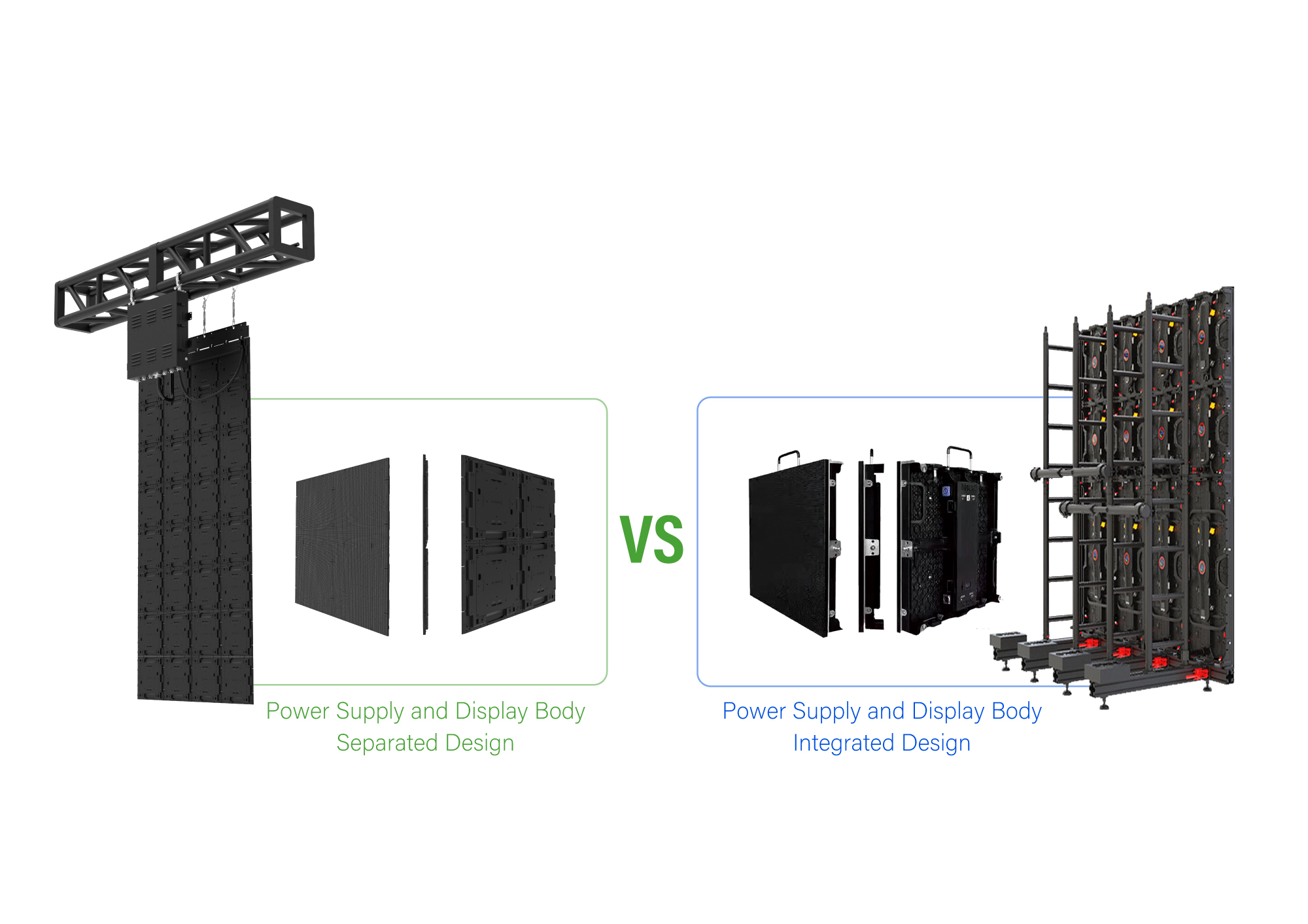
Structure comparison. Removing the cabinet is what reduces weight, depth and assembly labour at the same time.
Durability: what keeps a rolling panel working after repeated cycles
A rolling format introduces a specific risk that a fixed cabinet does not have: repeated rolling and unfolding stress, mechanical structure reliability, module connection stability and long-term operation performance. Onumen's stated control measures are a precision roller mechanism design, an optimised module connection structure, a controlled rolling speed, and strict durability testing. Continuous cycle testing and aging tests are run as part of that programme, and complete quality inspection is carried out before shipment.
For a rental fleet, this is the single most important engineering question to interrogate. Panels that are rolled twice a week for years see a different duty cycle from a panel installed once in a showroom, and the supplier's test regime should reflect it.
Compliance and engineering proof
Stage and advertising projects usually require the compliance file before the purchase order, not after. Onumen's Rolling Rollable LED Display (FRL/FRSL) holds CE LVD certification BST13030465Y-1SC-2 and FCC verification BST13030465Y-1EC-3. Onumen also states that its products are certified to TÜV, CE, RoHS, FCC and CCC, and that its production holds ISO management system certificates.
The rolling mechanics are covered by patents including EP 2755459 and KR 10-1692125. Onumen states that it owns a patent pool spanning Asia, Europe, the Americas and Oceania. For a buyer evaluating a long-term supply relationship, granted patents are a useful signal that the rollable format is an engineered mechanism with an owner, not a modified rigid panel.
Product specification detail is available at the model level: the FRL indoor rolling screen covers pixel pitches of 1.25 mm, 1.56 mm, 1.953 mm, 2.6 mm and 3.9 mm, which allows a project to match pitch to viewing distance instead of standardising on one panel.
From Site Survey to Curtain-Up: A Step-by-Step Breakdown
The sequence below reflects how a rolling LED installation is typically specified and executed. Steps 1–3 are where most stage failures are prevented.
- Survey the venue and the rigging plot. Record available rigging points, ceiling height, usable stage depth, load-in path width, door height and power drops. Because the panel is 12 kg/㎡ and 14 mm thick, these numbers can be checked against the screen area rather than the other way round.
- Fix the viewing distance and set the pixel pitch. Choose from the FRL pitch range (1.25 mm to 3.9 mm) based on the closest audience seat, not the largest screen the budget allows. A finer pitch is not automatically the right answer for a stage with a 20 m viewing distance.
- Define the curve and the screen geometry. Decide whether the backdrop is flat, curved, circular or wave. Confirm the number of panels required to complete the shape and confirm it against the control card capacity — one control card supports up to 76 ㎡ — so the control architecture is settled before fabrication.
- Plan transport around flight cases, not cabinets. At 40 ㎡ per 1 m³, calculate case count and truck space early. This is usually the point where a touring set gains a vehicle instead of losing one.
- Hang or stand the panel and form the curve. The cabinet-free panel is positioned and shaped in place. The Easy Sailing Series is designed so that a single unit can be installed by one person in around five minutes, which matters for changeover-heavy schedules.
- Commission the control system. With fewer control cards and simplified cabling, commissioning is the point where the reduced case count converts into schedule headroom before doors open.
- Roll down, pack, and log the cycle. Load-out is where the durability question is answered. Controlled rolling speed and a consistent packing routine protect the roller mechanism across the life of the panel.
Use Cases: Where a Rolling Unit Is the Right Answer
Rolling formats earn their place where space, weight or curvature is the binding constraint. Typical applications include:
- Concert and touring stage LED roll-up screens where the rigging plot is fixed and the set changes between cities.
- Event and conference LED roll-up screens in hotel ballrooms and conference centres with low ceilings and short get-in windows.
- Corporate showroom and product launch installations where a curved or wave backdrop is part of the brand design.
- Church and theatre display screens in older buildings where structural reinforcement is not an option.
- Airport and stadium advertising roll-up screens where panels must be moved into position within a live operating environment.
- Trade show and exhibition builds where freight volume and one-person assembly directly affect cost per show.
Where Magic Plus and Smart T Plus Fit Better
A rolling panel is not the automatic answer for every stage. Two adjacent formats should be compared before the specification is locked:
- Magic Plus is a rigid foldable format. Where the set needs a defined, stable plane — a flat hero wall, a fold-out structure, a shape that must hold a hard edge — a folding format can be the better match than a rolling one.
- Smart T Plus is a transparent display format. Where the design intent is to see through the screen — to a set piece, a window, a lighting rig or an architectural feature behind it — transparency is a design requirement that a rolling panel does not address.
The practical rule: choose the rolling FRL/FRSL format when curvature, weight, packing volume or install labour is the constraint; choose a folding format when a rigid plane is the constraint; choose a transparent format when sightlines through the screen are the constraint. Confirm the final configuration against the manufacturer's current specification sheet for the selected model.
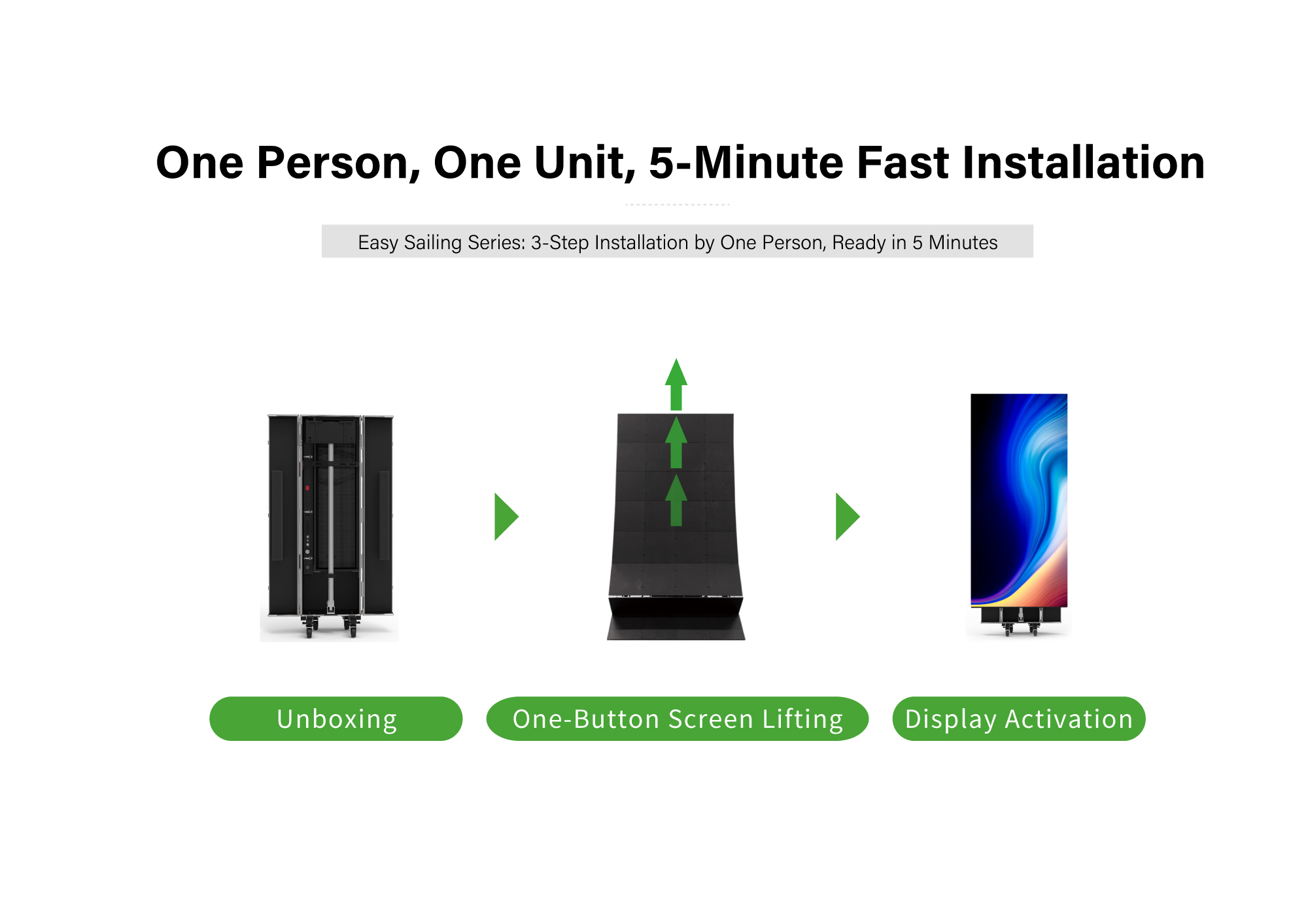
The Easy Sailing Series is designed so one person can install a single unit in about five minutes.
Comparison Table: Rigid Cabinet vs Folding vs Rolling Formats
The table below compares Onumen's flexible panel platform against a traditional cabinet LED display on the metrics that decide whether a stage build succeeds. Figures are manufacturer-stated comparisons and apply to the flexible platform, which is the basis for both the folding and rolling series.
| Criterion | Traditional cabinet LED display | Folding LED (flexible platform) | Rolling LED (FRL/FRSL) |
|---|---|---|---|
| Enclosure | Rigid cabinet with frame | Cabinet-free flexible panel | Cabinet-free flexible panel on a roller |
| Weight | Baseline | 12 kg/㎡ — about one third of baseline | 12 kg/㎡ — about one third of baseline |
| Thickness | Baseline | 14 mm — about one fifth of baseline | 14 mm — about one fifth of baseline |
| Format change | Fixed flat plane | 360° folding | 360° rolling and curling onto a roller |
| Curved backdrop | Stepped angling or custom steel subframe | Shaped by folding | Continuous curve when unrolled |
| Transport volume | Baseline | About one quarter of baseline | 40 ㎡ per 1 m³ flight case |
| Installation labour | Baseline | About one sixth of baseline | 100 ㎡ with 2 people in about 1 hour |
| Control architecture | Multiple cabinets and controllers | One control card up to 76 ㎡ | One control card up to 76 ㎡ |
| Best stage case | Fixed installs with ample depth and rigging capacity | Sets needing a defined rigid plane | Curved backdrops, low ceilings, tight rigging and short get-ins |
Weight, thickness, volume and labour comparisons are Onumen-stated figures for its flexible panel platform measured against traditional cabinet LED displays.
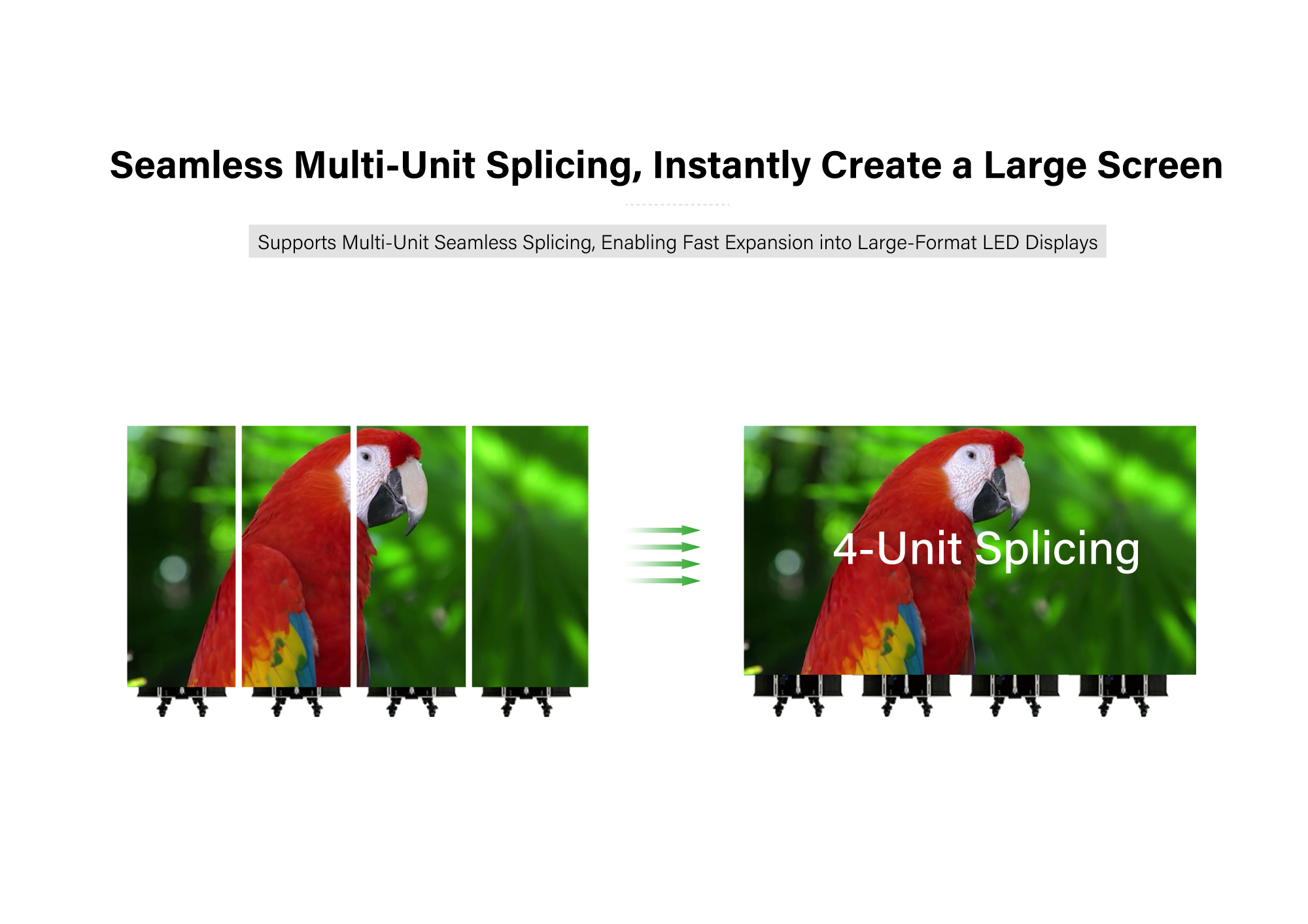
Multi-unit splicing allows a rolling panel system to build a continuous backdrop at stage scale.
Choosing a Long-Term Rollable LED Screen Partner, Not Just a Screen
For a rental operator or an event group buying for multiple venues, the purchase decision is really a supplier decision. Four checks separate a durable partnership from a one-off transaction.
Test regime and failure documentation
Ask what is actually tested and how. Onumen's stated programme covers continuous cycle testing and aging tests, plus complete quality inspection before shipment — the specific controls aimed at repeated rolling and unfolding stress, mechanical structure reliability and module connection stability. For a fleet that will be rolled hundreds of times, a documented test regime is more useful than a warranty promise with no test behind it.
Certification stability for market access
Certification is not a one-time purchase requirement. It determines whether a screen can be deployed into a given market at all. The CE LVD certification BST13030465Y-1SC-2 and FCC verification BST13030465Y-1EC-3 on the FRL/FRSL series give buyers in the EU and US a documented starting point, alongside RoHS and TÜV coverage across the wider range.
Commercial terms that support a pilot
The minimum order quantity for rollable LED display products is 1 m² or 1 unit. That low entry point allows a buyer to bring in a single panel, put it through a real install cycle, and evaluate the rolling mechanism before committing to a fleet. Delivery terms offered are EXW, FOB, CIF and DDP with international shipping support, and payment terms are T/T, L/C and Trade Assurance where applicable. Acceptance is supported by pre-shipment inspection, video inspection and functional testing before delivery.
Engineering ownership
A rollable screen has a mechanism at its core, and mechanisms need owners. Patents EP 2755459 and KR 10-1692125 sit alongside Onumen's stated patent pool across Asia, Europe, the Americas and Oceania. For a distributor building a catalogue, that is a relevant point when positioning the format to clients who will ask whether the product is genuinely engineered or simply a flexible panel repackaged.
Frequently Asked Questions
- What certifications should a rollable LED screen supplier provide for stage and advertising projects?
- Onumen's Rolling Rollable LED Display (FRL/FRSL) holds CE LVD certification BST13030465Y-1SC-2 and FCC verification BST13030465Y-1EC-3. Onumen also states that its products are certified to TÜV, CE, RoHS, FCC and CCC. For EU deployment, the CE LVD document is the file that speaks to electrical safety; for the US, it is the FCC verification. Buyers should request the certificate numbers from the supplier and confirm the certificate holder name matches the entity they are contracting with.
- How is repeated rolling and unfolding stress handled over a multi-year rental cycle?
- Onumen addresses this through precision roller mechanism design, an optimised module connection structure, controlled rolling speed and strict durability testing. Continuous cycle testing and aging tests are run to verify long-term operation performance, and complete quality inspection is carried out before shipment. The risk categories covered are repeated rolling and unfolding stress, mechanical structure reliability, module connection stability and long-term operation performance.
- Is the rollable format protected by patents?
- Yes. Onumen cites patents including EP 2755459 and KR 10-1692125 covering the rolling format, and states that it owns a patent pool spanning Asia, Europe, the Americas and Oceania. For buyers, granted patents in the target manufacturing and sales regions indicate that the rolling mechanism is an engineered, owned design rather than an assembly of purchased parts.
- What is the minimum order quantity and what commercial terms apply?
- The minimum order quantity for rollable LED display products is 1 m² or 1 unit. Delivery terms include EXW, FOB, CIF and DDP with international shipping support. Payment terms are T/T, L/C and Trade Assurance where applicable. Acceptance is supported by pre-shipment inspection, video inspection and functional testing before delivery.
- How can a buyer validate a rollable screen before a multi-venue rollout, and what is the next step?
- Start with a single unit at the 1 m² / 1 unit minimum and put it through a real load cycle. The Easy Sailing Series is designed so one person can install a single unit in about five minutes, which makes a short validation window realistic, and pre-shipment video inspection plus functional testing lets the buyer review the panel before it ships. For projects with a fixed date, the practical next step is to send Onumen the venue survey numbers — rigging points, ceiling height, stage depth and viewing distance — and request a specification and quotation for the FRL/FRSL configuration that fits.
Specifying a rollable stage screen?
Send Onumen Technology Co., Ltd. your rigging plot, ceiling height, stage depth and viewing distance, and ask for an FRL/FRSL configuration with the CE and FCC documentation attached. Sample requests and single-unit orders start at 1 m² or 1 unit.
Web: www.onumen.com | Email: sales@onumen.com | Tel: +86 755 8360 1688 | WhatsApp: 18926440672
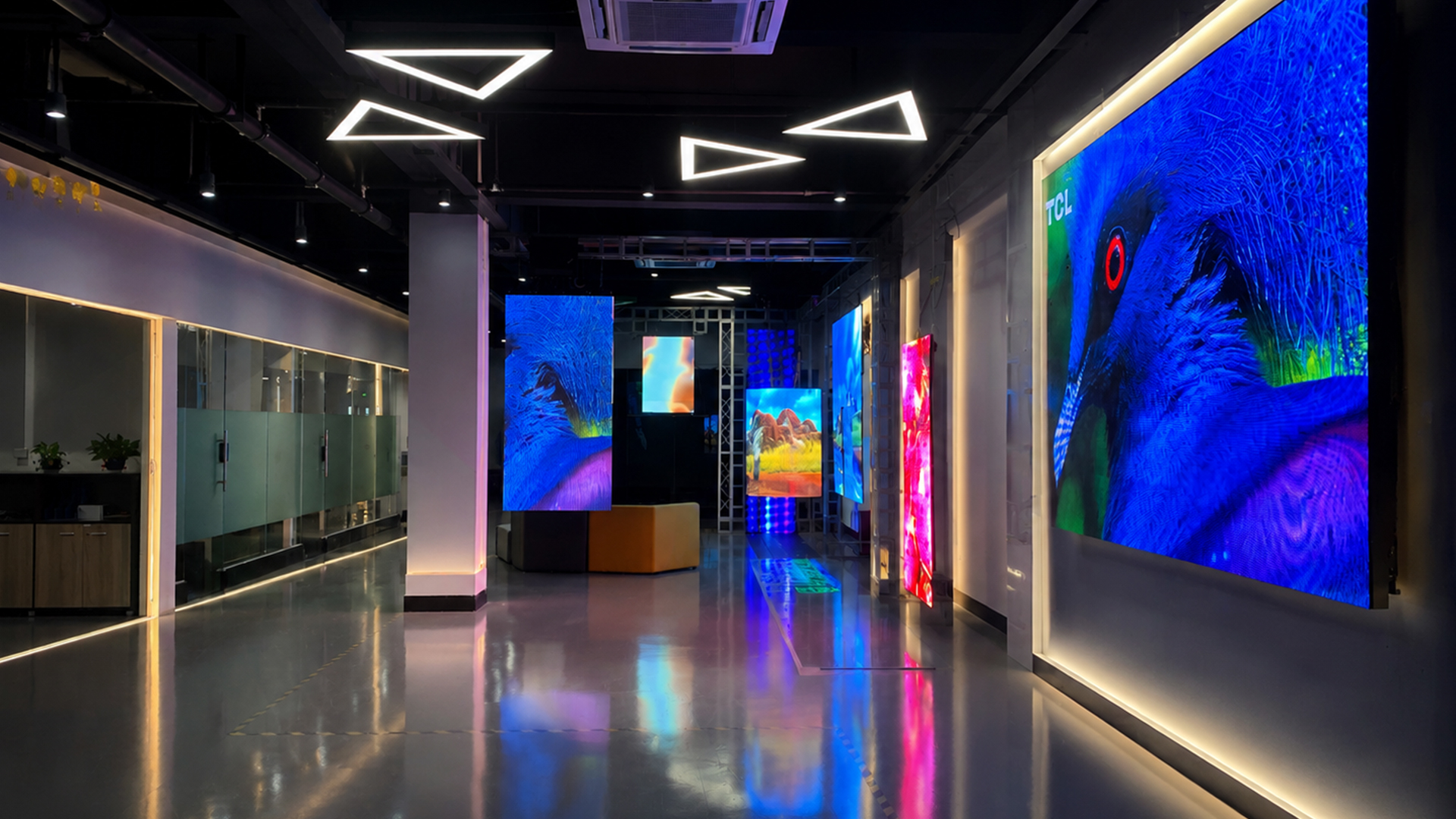
Onumen Technology's exhibition hall in Shenzhen, where folding, rolling and transparent formats are demonstrated for buyers.
Conclusion
Stage setups fail in predictable places: at the truss, behind the backdrop, on the curve, and inside the get-in window. All four are properties of the cabinet, which is why a rollable LED screen changes them together. At 12 kg/㎡ and 14 mm, with 360° rolling, 40 ㎡ per 1 m³ flight case and 100 ㎡ installed by two people in about an hour, the FRL/FRSL format moves the constraint away from the structure and back onto the design.
The engineering checks that support that claim are specific and documentable: CE LVD certification BST13030465Y-1SC-2, FCC verification BST13030465Y-1EC-3, patents EP 2755459 and KR 10-1692125, and a durability programme built around continuous cycle testing and aging tests. Where a project needs a rigid plane or a see-through surface instead, Magic Plus and Smart T Plus cover those cases as complements rather than substitutes.
For buyers at the decision and execution stage, the useful sequence is straightforward: survey the venue, set the pitch from the viewing distance, choose the format by constraint rather than by habit, and validate with a single unit before committing to a fleet.
Have Questions or Need More Details?
Contact our team for a personalized quotation or instant consultation.
Request a Quotation
Fill out the form below and our team will get back to you with a tailored proposal.
WhatsApp Direct Chat
Prefer to chat in real-time? Message us on WhatsApp for instant assistance & quick answers.
- Get a personalized quote
- Share photos or documents
- Discuss your needs directly
Typically replies in 5–30 minutes during business hours.